Pierre Jeanneret: The Transformation and the Classification of His Work
Pierre Jeanneret (1896–1967) is among the most influential—though often underestimated—figures of modern architecture and furniture design of the 20th century. As the office partner and cousin of Le Corbusier, he shaped the development of modern architecture over more than three decades and created furniture designs that are now regarded as icons of 20th-century design. His late work in Chandigarh, the purpose-built capital of the Indian state of Punjab, represents a culmination of his career and documents with particular clarity his approach to linking modernism with local context and climatic conditions.
Early Years and Education
Pierre Jeanneret was born on 22 March 1896 in Geneva, into a family already rooted in architectural traditions. His cousin Charles-Édouard Jeanneret, later known as Le Corbusier, was thirteen years older and would exert a decisive influence on Pierre’s professional trajectory. Pierre completed his education at the École des Beaux-Arts in Geneva. In January 1920 he left Switzerland and moved to Paris, where from 1921 to 1922 he worked in the office of the Perret brothers. This experience under Auguste Perret, a pioneer of reinforced concrete construction, proved formative for his later work.
In 1921 he began a partnership with Le Corbusier while still employed by the Perret brothers. In 1922 they founded an office together. This collaboration proved exceptionally productive and led to the realization of some of the most significant buildings of classical modernism. Although Le Corbusier was often perceived as the sole author of their joint projects, Pierre Jeanneret was in fact an equal partner, contributing both conceptually and practically to the development and execution of the designs. The two shared research interests and design principles within a deep and lifelong professional relationship. Together they developed the “Five Points of a New Architecture” (Cinq points de l’architecture moderne, 1927), which became cornerstones of the modern movement: pilotis, the roof terrace, the free plan, the horizontal window, and the free façade.
During the eighteen years of their partnership they realized numerous pioneering projects that became icons of modern architecture. Among the most notable joint works are:
– Villa Le Lac (1923–1924) – a compact house with a refined interior.
– Maisons La Roche-Jeanneret, Paris (1923–1925) – a masterpiece distinguished by its “promenade architecturale.”
– Ozenfant House, Paris (1922) – an experimental building type combining dwelling and studio in a compact structure.
– Pavillon de l’Esprit Nouveau (1925) – a counter-proposal to the dominant Art Deco, presented at the Exposition Internationale des Arts Décoratifs.
– Weissenhof Estate, Stuttgart (1927) – two model houses exemplifying their architectural principles.
– Maison Cook, Boulogne-sur-Seine (1926) – an innovative urban house with characteristic pilotis construction.
– Maison Guiette, Antwerp (1926) – an early example of their principles in Belgium.
– Villa Savoye, Poissy (1928–1931) – regarded as the consummate manifesto of modern architecture and the culmination of their purist phase.
– Villa Baizeau, Tunis (1929) – demonstrating the adaptation of modernist principles to a Mediterranean climate.
Further important projects included the Cité Frugès in Pessac near Bordeaux (1924–1927), an ambitious social housing project of around fifty houses, and the Fondation Suisse, a student residence (1931–1933). Their activities also extended to urban planning. They developed visionary schemes such as the Ville Contemporaine for three million inhabitants (1922) and the Plan Voisin for Paris (1925), which provoked controversial debates about the future of the city. In 1927 they participated in the competition for the Palace of the League of Nations in Geneva; although their design received the most jury votes, it was not realized for formal reasons. While Le Corbusier dominated the theoretical articulation and public presentation of their work, Pierre Jeanneret was integral to the entire design and realization process. His expertise in construction and detailing was as crucial as his formal contributions. This division of labor was characteristic of their collaboration and partly explains why Jeanneret’s role was long underestimated.
Furniture Design and the Collaboration with Charlotte Perriand
Another essential aspect of Pierre Jeanneret’s work is his contribution to furniture design. From 1927 onward, the office collaborated with designer Charlotte Perriand, resulting in a series of iconic furniture designs. Among the best known are the LC1 armchair (Basculant), the LC2 armchair (Grand Confort), and the LC4 chaise longue, now understood as joint projects by Le Corbusier, Pierre Jeanneret, and Charlotte Perriand.
These pieces represented a radical departure from traditional furnishing concepts. They employed modern materials such as chrome-plated tubular steel. The furniture was not conceived as decorative objects but as équipement de l’habitation—equipment for modern living—combining comfort with an industrial aesthetic.
The collaboration with Perriand was especially productive and led to a redefinition of modern furniture design. While Le Corbusier often set the conceptual direction, it was Jeanneret and Perriand who undertook the practical development and refinement of the designs. First presented in 1929 at the Salon d’Automne in Paris, the furniture provoked debate. It marked a turning point in European furniture design and influenced generations of designers.
The Years in Grenoble and the BCC (1940–1950)
After the end of the partnership with Le Corbusier in 1940—partly due to personal differences and the changed circumstances of the Second World War—Pierre Jeanneret settled in Grenoble. As early as 1939, together with Charlotte Perriand, Jean Prouvé, and the journalist, sports manager, and entrepreneur Georges Blanchon, he had founded the Bureau Central de Construction (BCC), a company developing prefabricated, low-cost, and demountable building systems.
During the Second World War Jeanneret was actively involved in the French Resistance under the code name “Guidondevélo,” working alongside colleagues Georges Blanchon and Jean Prouvé. At the same time, BCC advanced pioneering projects in lightweight prefabrication and demountable housing—projects now regarded as among the most formative contributions to French postwar design. BCC was dissolved in 1952.
The Chandigarh Project from 1951
Another transformation in Pierre Jeanneret’s career came after 1950. Following the partition of India in 1947, the state of Punjab lost its capital Lahore, which became part of Pakistan. The Indian government under Prime Minister Jawaharlal Nehru decided to build a new capital, Chandigarh, as a symbol of a modern, independent India. In 1950 Le Corbusier was commissioned to design the city. He brought Pierre Jeanneret into the project—a decision that proved decisive for the success of this ambitious undertaking.
While Le Corbusier was primarily responsible for the monumental government buildings of the Capitol Complex and traveled to Chandigarh only occasionally, Pierre Jeanneret assumed the day-to-day leadership of the project on site. From 1951 to 1965 he lived and worked in Chandigarh, dedicating himself to the implementation of the urban plan. His buildings responded more directly to local needs and conditions and were more pragmatic than those of Le Corbusier. He was responsible for the design of numerous public buildings, including schools, hospitals, administrative buildings, and housing complexes.
His designs were marked by an intelligent adaptation of modernist principles to the humid subtropical climate of northern India. He developed innovative solutions for sun protection, natural ventilation, and heat dissipation, making the buildings more habitable and functional. He created various housing types for different population groups and income levels that were both affordable and architecturally complex. These designs took Indian living habits and family structures into account, integrated traditional elements such as verandas, and consistently combined them with modernist principles. The buildings used local materials, especially brick and concrete, and were conceived so they could be executed by local craftsmen.
The Chandigarh Furniture
A) Experimental Phase
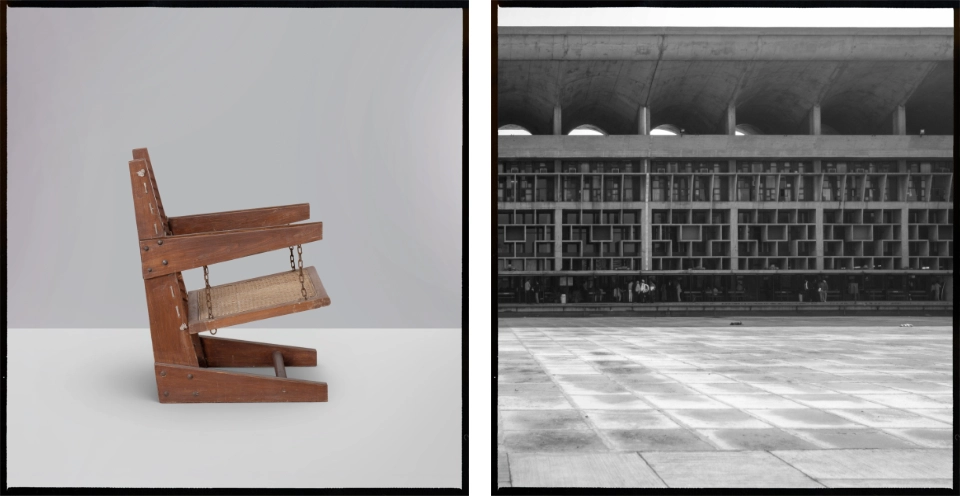
Parallel to his architectural work, Pierre Jeanneret developed extensive furniture for Chandigarh’s public buildings and for specific housing projects. This furniture constitutes an independent contribution to the design canon of the 20th century. It differs both from his earlier work and from other tendencies of regionalist modernism. The early objects, particularly the seating furniture up to 1955 (now catalogued as PJ-SI-011 to PJ-SI-12), display a wild, almost childlike experimental spirit. Chairs were constructed from bamboo, rope, metal frameworks, cane, or chains; they were demountable and deliberately ignored the aesthetic principles of modernism. It appears as though Jeanneret created a liberated experimental field in which he cast aside dogma, professionalism, and the stylistic imperatives of modernism.
A particularly striking example is the chair PJ-SI-07-A, whose seat hangs from the armrests by chains. Many of these objects were easy to produce—bamboo lashed together with a few ropes or other improvised constructions. The furniture exhibits a pragmatic, architectural formal language: frameworks support light seat and back surfaces. The contrast between load-bearing and load-borne elements emphasizes constructive logic and lends the objects a raw, almost sculptural quality. Yet these early designs were often too fragile for everyday use; they remained prototypes documenting Jeanneret’s unrestrained creative drive.
B) Archetypal Design
A more unified formal language and logic soon crystallized. This made it possible to furnish an entire city with furniture types that local craftsmen could produce using available materials. Teak or sissoo beams, assembled into A-, X-, Z-, or bridge-like forms, constitute the structural framework and grammar of most pieces. Western formal clarity meets Indian nonchalance, resulting in a liberating directness without excessive formalism. Did Pierre Jeanneret recognize in non-design the highest form of design—a form in which the poetry of the everyday takes precedence over ambitious formal compulsion? Simple, clear forms generate an almost banal simplicity. Were it not for the small refinements: certain edges rounded, beams tapering toward their ends, fixings cleverly concealed, and particular attention paid to proportions.
India was a liberation for Pierre Jeanneret. Proximity to life and its beauty became more decisive. The same tendency appears simultaneously in Le Corbusier’s work. Archaic and primitive furniture types came into focus. In 1952 he developed a stool for his Cabanon that was nothing more than a box, and in 1953 a stool for his projects in Ahmedabad consisting of a steel tube and a banal seat.
Although functional and pragmatic aspects always played a role in Pierre Jeanneret’s Chandigarh project, this should not be described as functional design. The underlying intention was to create the essential with everyday means. Both Pierre Jeanneret and Le Corbusier sought the essential, with the poetic always forming part of it. In Jeanneret’s case this was more pragmatic and closer to people; in Le Corbusier’s work an additional spiritual and visionary dimension emerged.
Pierre Jeanneret returned to Switzerland in 1965 after fourteen years and died on 4 December 1967 in Geneva.
[:fr]Img fr[:]