Design and Chandigarh Objects – Investment Potential for 2026
2020 to 2025: The Market Under Stress Test
The Covid years 2020 and 2021 were generally difficult for the art trade. Without exhibitions and fairs, trade nearly came to a standstill. Traditional art galleries without an online presence suffered more than digitalized houses. Design furniture galleries with an online presence, however, experienced demand: collectors who were now stuck at home invested in upgrading their homes. The second crisis lasted from 2022 to 2025: inflation, recession fears, geopolitical tensions, and trade wars led to a hesitant buyer base. Globally, the art trade fell by 12% in 2024, and the auction market collapsed by 7% in the first half of 2025.¹ Revenue drops by major players such as Hauser & Wirth by 50% are cause for concern.²
A generational shift in the buyer base additionally emerged, something that happened gradually but now suddenly hit the design gallery scene and created new collectors as well as requirements. Among high-net-worth individuals, boomers (born 1946 to 1964) continue to represent the collector group with the strongest revenue: they buy expensive but few works. In terms of revenue, millennials (born 1981 to 1996) follow, dominating the market at 55%.³ The experimental Generation Z buys in the greatest numbers, but less expensive design objects, and continuously builds their collections. The market is undergoing a transition that demands more quality and innovation, an opportunity for the entire design market.
Design Establishes Itself as an Investment
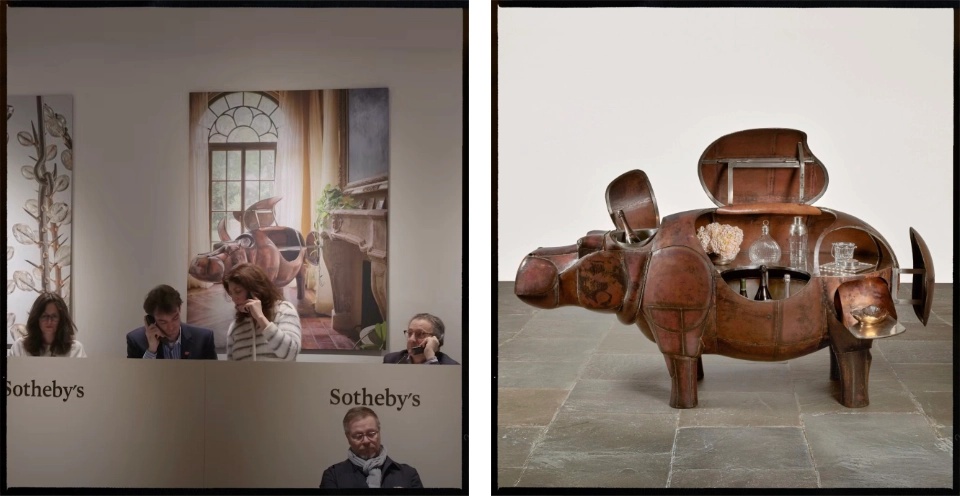
Design has moved from a marginal position into the traditional repertoire of collectors. Where design enthusiasm was once confined to a niche area and considered an insider tip, a broad audience is now interested in design. The Art Basel and UBS study for 2025 shows that 20% of surveyed art collectors (high-net-worth individuals) intend to incorporate design into their collection. Just a few years ago, fewer than 3% wanted to add design to their portfolio. These interested parties view design as undervalued compared to traditional art with comparable quality characteristics. Design is no longer considered an experimental field but a serious collecting area and legitimate investment.Only for about 35 years has design established itself as a relevant collectible object. Institutions such as the Vitra Design Museum, Centre Pompidou, MoMA, auction houses like Wright, Piasa, Christie’s, Phillips, Sotheby’s, and fairs like Design Miami (since 2005) legitimized design as cultural property. The market has reached the phase where furniture objects become collectible investments. While between 2000 and 2020 about 20 design objects achieved prices over 1 million USD at auctions, in 2024 and 2025 alone more than 20 design objects exceeded this threshold. A remarkable acceleration. Design objects by Eileen Gray, Jean Prouvé, Carlo Mollino, Diego Giacometti, Frank Lloyd Wright, or François-Xavier Lalanne, whose Hippopotame Bar just achieved a new record at 31.4 million dollars,⁴ exemplify this development.Design proved crisis-resistant from 2020 to 2025. While the art market suffered between 2022 and 2025 and a price decline was evident, prices in the design market merely stagnated. This resilience makes design interesting for the future and suggests that demand is growing and prices are generally not overvalued.
The Investment Potential of Chandigarh Objects
A) Historical Relevance and Market Position
The design of the first half of the 20th century remains unique because of its historical significance and innovation. This era represents the nucleus of the entire design tradition to this day. Pierre Jeanneret and Le Corbusier are still considered the most significant and influential architectural team of our era. This position is historically established and will no longer be relativized even by new designers. These facts define the relevance and value of their works.
Prices for Chandigarh objects have shown their own dynamic over the last 30 years. With the “rediscovery” around 2005, a price explosion occurred. In the hype and price-driving phase cultivated by galleries together with auction houses, an “Office Cane Chair PJ-SI-28-A” reached a price of 12,500 dollars⁵ (today’s value about 4,200 dollars). In 2015, it became apparent that many objects were not as rare as claimed, leading to a price correction. The emergence of counterfeits contributed to uncertainties and additionally impaired prices. Prices have been rising continuously again for several years, after questions of rarity have been clarified and clearer ideas exist regarding authenticity. Objects that combine rarity with usability developed particularly well. Armchairs from Chandigarh, for example, are sought after: collector’s item, residential object, and status symbol in one.
B) Value Factors and Investment Criteria
Authenticity is decisive. Uncertainty is reflected in restrained bids at auctions, while rare pieces with secured provenance achieve top prices. Prices jump or fall when originals can no longer be distinguished from counterfeits. The significance of authenticity and provenance is increasing and ensures that design as an investment does not suffer loss of value. Certificates on blockchain technology make provenance verifiable and traceable. This technology, successfully used for diamonds to exclude problematic origins, is increasingly finding application in the design market as well.
Price development also increasingly depends on the quality of restoration and patina. Until about 2015, over-restoration was not uncommon: patina was replaced, traces of use eliminated, the surface freed from its history. Such objects are losing value today because these interventions erase important authenticity indicators. Priorities have shifted. Objects with rich patina and subtle, careful restoration gain more value. Patina, rust, and original paint finishes are increasingly appreciated, a development that is intensifying.
The art historical relevance of the designer, limited availability, clear distinction of original first editions from later reproductions, all this promotes value appreciation. Narrative aspects shape value to the same degree. If a myth developed around the designer or object, desire increases and thus also collector value.
Concluding Observations
Chandigarh objects are among the most valuable collector’s items in design and have proven their lasting relevance. The strongly increasing demand across all collector generations, the grown trust in design as an investment, and the sharpened attention to authenticity documentation create stable conditions for the market and legitimize value appreciation. This development will intensify in 2026.
¹ Clare McAndrew, Survey of Global Collecting (Basel: Art Basel and UBS, 2025), 21.
² Tippinpoint, “Schweizer Stargalerist Iwan Wirth: Brechen die Geschäfte in Grossbritannien ein?,” accessed December 27, 2025, https://www.tippinpoint.ch/artikel/78340/schweizer_stargalerist_iwan_wirth_brechen_die_geschaefte_in_grossbritannien_ein.html.
³ Clare McAndrew, Survey of Global Collecting (Basel: Art Basel and UBS, 2025), 46.
⁴ Sotheby’s, “Hippopotame Bar, Piece Unique,” Important Design Featuring the Schlumberger Collection, 2025, https://www.sothebys.com/en/buy/auction/2025/important-design-featuring-the-schlumberger-collection/hippopotame-bar-piece-unique.
⁵ Phillips, “Pierre Jeanneret, Pair of ‘Office’ Armchairs, Model No. PJ-SI-28-A,” accessed December 25, 2025, https://www.phillips.com/detail/pierre-jeanneret/77818?fromSearch=pj-si-28&searchPage=1.
Photographs © Sotheby’s.
[:fr]Img fr[:]