
AUTHENTIC DESIGN ARTEFACTS




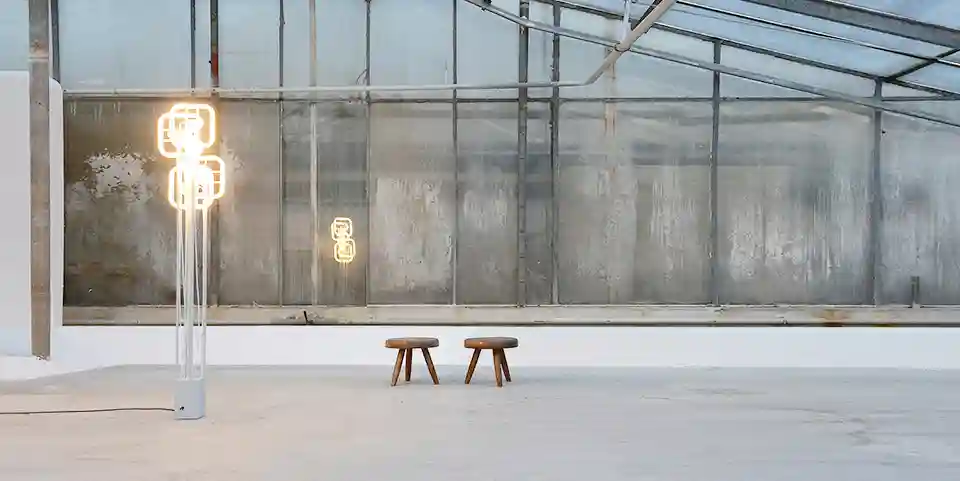
We present non-conformist design – rough and unforgiving.
Never accessories. Always resistance.
CATALOGUES

CONTEMPORARY 21. CENTURY
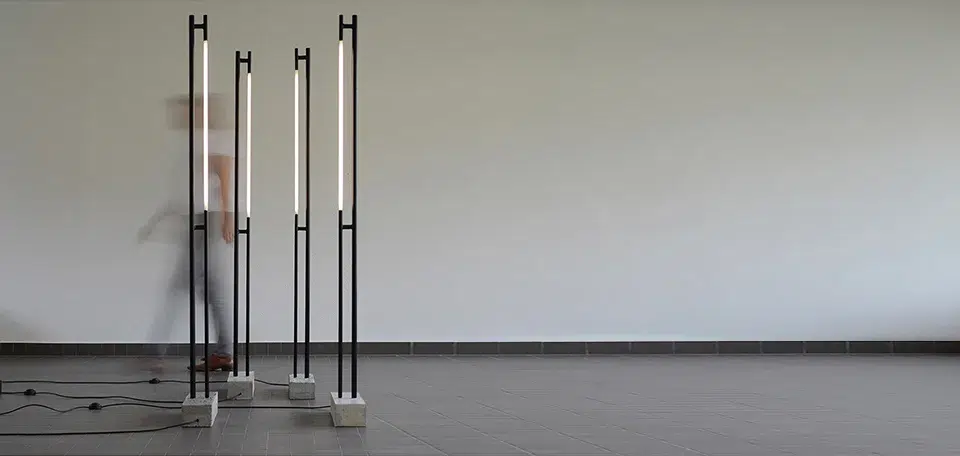
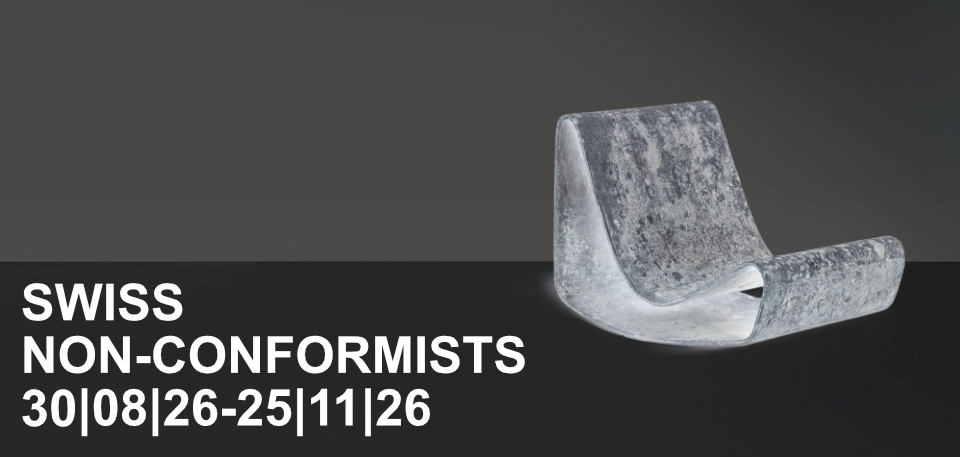
Objects without obedience.
Radical. Unwilling to please.
1STDIBS
YOUTUBE
ARTSY
Pierre Jeanneret Chair – Original Chandigarh Furniture at P! Galerie Zurich
History of Chandigarh
In 1951, Le Corbusier was commissioned to design Chandigarh as the new capital of Punjab, India. Pierre Jeanneret, his cousin, took the role of chief architect on site and spent 15 years in India, from 1951 to 1965.
While Le Corbusier designed the monumental government buildings on the Capitol Complex, Jeanneret designed together with B.P Mathur the Gandhi Bawan and other administrative buildings. He developed the entire furniture program for the new city — furniture for administrative buildings, universities, residential buildings, the High Court, and public institutions.
These interior designs and the furniture were not secondary. They were part of a political and social experiment: a modern, democratic capital in post-colonial India. Each furniture piece had to function — fitting to the Indian climate, with local materials, made by local craftsmen, repairable without imported parts.
Jeanneret was not designing objects for a European clientele, but experimented with a new language. The challenge was fundamental: How do you translate modernist principles into an Indian context? How do you create furniture that is functional, producible, and formally coherent? How do you create objects that are also visionary?
Jeanneret’s answer was a logic of necessity — reduced to structure, material, and function. But Pierre Jeanneret didn’t have a purely functional or pragmatic approach. Pragmatism got here a vision and found its own visual language.
Material Production and Markings on Chandigarh objects
Mostly, Jeanneret worked with Indian teak, sissoo wood, cane, metal, and bamboo. The furniture was built in Chandigarh’s government workshops, not in European factories. This meant: traditional joinery rather than machine precision, adjustments to available tools, local timber dimensions, local climatic conditions.
This mode of production produced variations. Different workshops used slightly different measurements. Wood joints show individual craftsmanship. This is the way how markings and stamps appeared on the Chandigarh items. A result of simplifying the production or to keep track of which item belonged to which building. . Some chairs carry stamps of the producing authority: “PEC” (Punjab Engineering College), “PU” (Panjab University), objects from the High Court carry markings such as HC. These details are not flaws — they are markers of authenticity and make the object’s history legible. Visible on objects from administrative buildings. Objects from residential buildings were usually without these markings.
The constructive solutions were not about technical perfection, as known from the projects by Pierre Jeanneret, Charlotte Perriand and Le Corbusier in Europe. It was important to find a fitting solution for such a huge project in the Indian reality. This challenge led to a different solution, making Chandigarh items so different to other Mid-Century design.
The cane weaving was done by local craftsmen, often reflecting regional patterns. After some time the cane was replaced by plastic straps. Jeanneret did not impose total control; he allowed room for interpretation. The result: furniture between European modernism and Indian craft.
Iconic Chandigarh Furniture Models and Their Function:
PJ-SI-28-B, called “Office Cane Chair” or “Capitol Chair”:
The Jeanneret chair is designed for Chandigarh’s administration buildings. The A-shaped legs distribute load ideally and became a signature element of Chandigarh furniture objects. The chair has a simple massive structure with a curved backrest, which is fixed with 2 beams to the seat. The backrest and the seat are covered with cane. Everything appears optimised for stability with minimal material. Each element has a structural role. The Chandigarh chair. is done in teak or sissoo wood.
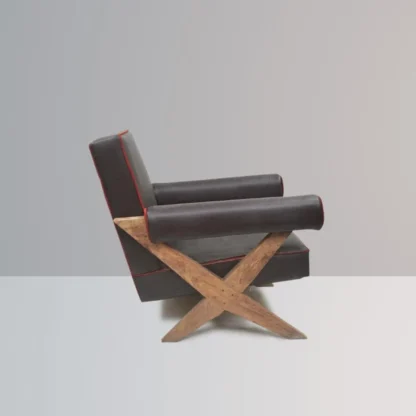
PJ-SI-59-A “Kangaroo” Lounge Chair: Designed for waiting areas and libraries. The iconic wooden wave — a clear gesture. The name comes from dealers, not from Jeanneret. The low seat of that armless chair is done in teak or sissoo wood and with cane, is expressing a specific nonchalance, fitting to the vision of Chandigarh.
PJ-SI-33-C Jeanneret Cane Bench: A cane bench for the Assembly at the Capitol Complex and for many residential buildings. An item with the characteristic compass legs, a feature – typical for many Chandigarh objects.
Capital Complex Chair PJ-SI-28-A:The Jeanneret chair has a backrest, which is not fixed to the seat but floating. A constructional refinement, which make this chair by Pierre Jeanneret in teak or sissoo wood to a valuable collector’s item. It is exhibited in several Museums like the Museum für Gestaltung in Zürich or the Victoria and Albert Museum in London.
Shelving and Storage System
There were smart storage solutions in Chandigarh. The most famous is the PJ-R-27-A, pigeon file rack. A simple structure, done without screws.
Provenance, Authenticity, Certificates and Blockchain
The Chandigarh furniture market is complex. After Jeanneret’s death in 1967, the city held thousands of pieces. In the 1970s and 80s, they were considered outdated, and many were discarded while others ended up in markets and were exported.
Systematic collecting began only in the 2000s, followed by reproductions. Today, three categories exist: verified pieces with documented origin; pieces with plausible Chandigarh provenance — correct materials, construction, and workshop traits — but without full documentation; and reproductions from the 2010s onward, some of which are high-quality and difficult to distinguish.
We deal only in verifiable originals. Authenticity markers are subtle: workshop stamps that are often faded or overpainted, construction details differing from original drawings, traces of use from decades of institutional service, and wood quality characteristic of 1950s–60s Indian production.
We sell exclusively Mid-Century items where all major parts are original to that piece. Each item comes with a certificate of authenticity secured via blockchain. This ensures complete transparency for future resale, even decades later. View the blockchain certificate.
What P! Galerie Does — and Does Not Do
We do not over-restore. A chair that stood for decades in a Chandigarh ministry carries traces: scratches, sun discoloration, wear from hands on the arms. This patina is history. That are important signs of authenticity. Removing it erases the object’s biography and value.
We conserve as little as possible, as much as necessary.
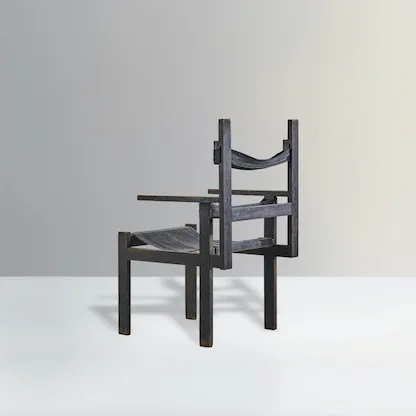
P! Galerie shows Jeanneret in context with related positions. Gerrit Rietveld’s work for Utrecht — furniture for social housing and public institutions — shares radical traits. Rietveld’s Red-Blue Chair is iconic.
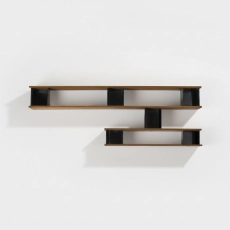
Charlotte Perriand’s shelving for Maison du Mexique (1952) shares with Jeanneret the idea of architecture and furniture as a unit. Her modular systems pose similar questions: spatial organisation, flexibility, conceptual limits.
Jean Prouvé’s school furniture for African colonies emerged from similar conditions: robust, affordable, locally producible. Prouvé’s industrial approach differs from Jeanneret’s craft-based one, but the underlying questions overlap.
Lina Bo Bardi’s furniture for Brazilian institutions (1960s–80s) follows a parallel path: European modernism filtered through local materials and conditions. Her seats for SESC Pompéia embody this radical stance.
Tom Strala’s work continues this line: reduced, politically readable, anti-commercial. Similar questions as Jeanneret asked seven decades earlier: How does form express a political attitude? How does design articulate critique?
Modern design was often dogmatic. Here other approaches appear. A form of poetic resistance becomes visible — giving the objects intensity and relevance.
The Showroom in Dietikon
The showroom does not stage living-room scenes. The furniture stands in architectural arrangements: visible height, top light, concrete floor. The aim is to understand structure, proportion, material — not to imagine a chair next to a sofa. The question: is the aura, the resistance, the intensity visible?
Visits by appointment. We take time. Collectors can examine pieces, inspect joints, study construction details. Photographs show furniture, but not weight, texture, subtle workshop differences.
The showroom also functions as a research space. We keep original Chandigarh documentation, archive material, correspondence, photographs. Collectors and researchers can study both furniture and context.
Who These Pieces Are For
Not for everyone. They are not comfortable in the sense of a padded armchair. Not perfect in the sense of Scandinavian factories. They are raw, direct, uncompromising.
They suit people who see architecture as social practice. Who care about material culture and design history beyond canonical narratives. Who accept a chair that poses questions instead of offering comfort.
Jeanneret’s furniture is not lifestyle décor. It is historical material that expresses a particular vision of modernity — democratic, functional, anti-elitist. Its roughness is intentional. Its imperfections are authenticity, not defect.
Collectors of these pieces do not collect styles; they collect positions. They are interested in how design shapes social realities, how furniture materialises ideology.
P! Galerie: is selling just Radical Design
P! Galerie is led by Pedja Hadzi-Manovic, architect (ETH Zurich), specialised in mid-century design and its material artefacts. The practice joins trade with research — every piece sold is also studied.
The focus is radical design — furniture that pushes formal, political, or social boundaries. Not mainstream modernism, but positions that are uncomfortable: ideologically, formally, materially. Jeanneret, Rietveld, Prouvé, Bo Bardi, Strala — all treat furniture like the Pierre Jeanneret Chair Chandigarh as resistance, experiment, reality.
Radical design means refusal of convention. No decorative gestures. No commercial accommodation. Material as social statement. Form as question. These pieces provoke through consistency, not spectacle.
However, financial value represents only one dimension of these objects’ importance. Pierre Jeanneret’s work resists decorative reduction. His chairs are not about pleasing — they are about refusal, and material honesty. Every original Pierre Jeanneret chair is an artefact of a political and architectural ideology. Chandigarh’s modernism is visible in these objects.
We work with museums, collectors, and institutions worldwide. Our presence on 1stdibs, Artsy, Art Basel, and Design Miami places us in the international discourse on architectural furniture. We also collaborate with auction houses such as Sotheby’s, Christie’s, Piasa, and Wright.
This dual role — commercial and curatorial — is intentional. The market for radical design needs expertise, context, standards. We see ourselves as mediators between historical objects and contemporary collecting, between academic research and practice. Not every mid-century piece is radical — we select by conceptual rigor, not trend.
Contact
P! Galerie, Dietikon near Zurich. Visits by appointment
Documentation and provenance research on request
For inquiries about available Pierre Jeanneret pieces or design by Charlotte Perriand, Le Corbusuier or Tom Strala, visits, or research on Chandigarh furniture, contact us directly.