<?xml version="1.0" encoding="UTF-8"?><feed
	xmlns="http://www.w3.org/2005/Atom"
	xmlns:thr="http://purl.org/syndication/thread/1.0"
	xml:lang="en-GB"
	>
	<title type="text">P! Galerie</title>
	<subtitle type="text">pierre jeanneret chair and charlotte perriand</subtitle>

	<updated>2026-11-25T01:15:01Z</updated>

	<link rel="alternate" type="text/html" href="https://www.jeanneret-chandigarh.com/en/pierre-jeanneret-chair" />
	<id>https://www.jeanneret-chandigarh.com/en/feed/atom</id>
	<link rel="self" type="application/atom+xml" href="https://www.jeanneret-chandigarh.com/en/feed/atom" />

	<generator uri="https://wordpress.org/" version="6.9.12">WordPress</generator>
<icon>https://www.jeanneret-chandigarh.com/wp-content/uploads/2023/04/jeanneret-chair-150x150.jpg</icon>
	<entry>
		<author>
			<name>Pedja Hadzimanovic</name>
							<uri>https://www.jeanneret-chandigarh.com</uri>
						</author>

		<title type="html"><![CDATA[Design and Chandigarh Objects: Investment Potential for 2027]]></title>
		<link rel="alternate" type="text/html" href="https://www.jeanneret-chandigarh.com/en/design-and-chandigarhobjekte-investitionspotential-for-2026" />

		<id>https://www.jeanneret-chandigarh.com/?p=11067</id>
		<updated>2026-11-25T01:14:56Z</updated>
		<published>2026-11-24T00:04:55Z</published>
		<category scheme="https://www.jeanneret-chandigarh.com/en/pierre-jeanneret-chair" term="Uncategorized" />
		<summary type="html"><![CDATA[<p>2020 TO 2026: THE MARKET UNDER STRESS TEST The Covid years 2020...</p>
<p>The post <a href="https://www.jeanneret-chandigarh.com/en/design-and-chandigarhobjekte-investitionspotential-for-2026">Design and Chandigarh Objects: Investment Potential for 2027</a> appeared first on <a href="https://www.jeanneret-chandigarh.com/en/pierre-jeanneret-chair">P! Galerie</a>.</p>
]]></summary>

					<content type="html" xml:base="https://www.jeanneret-chandigarh.com/en/design-and-chandigarhobjekte-investitionspotential-for-2026"><![CDATA[<style data-pg-indent>.single-post-page-11067 h1 + div{margin-left:clamp(1em,6vw,5.6em);text-align:left !important}.single-post-page-11067 .content > p{margin-left:clamp(1em,6vw,5.6em) !important}.single-post-page-11067 .content .postnewsleft{margin-left:clamp(1em,6vw,5.6em)}.single-post-page-11067 .content .postnewsleft p{margin-left:0 !important}.single-post-page-11067 .content u{text-decoration:none}.single-post-page-11067 .content p > u:first-child,.single-post-page-11067 .content p > em:first-child > u,.single-post-page-11067 .content .postnewsleft > u,.single-post-page-11067 .content .postnewsleft > em:first-child > u{display:block;margin-left:calc(-1 * clamp(1em,6vw,5.6em))}.single-post-page-11067 .content u + br,.single-post-page-11067 .content em:has(> u) + br{display:none}.single-post-page-11067 .content .pg-gray p{display:none}.single-post-page-11067 .content .pg-gray br{display:none}</style>
<p><u>2020 TO 2026: THE MARKET UNDER STRESS TEST</u><br />
The Covid years 2020 and 2021 were generally difficult for the art trade. Without exhibitions and fairs, trade nearly came to a standstill. Traditional art galleries without an online presence suffered more than digitalised houses.</p>
<p>Design furniture galleries with an online presence, however, experienced demand: collectors who were now stuck at home invested in upgrading their homes. The second crisis began in 2022: inflation, recession fears, geopolitical tensions and trade wars made buyers hesitant. Even the largest galleries felt it: the UK business of Hauser &amp; Wirth saw its revenue halve, from 144 to 68 million pounds.[1] The art market shrank until 2024 and returned to growth in 2025, by 4% to 59.6 billion dollars.[2] In the first half of 2026, Christie&#8217;s, Sotheby&#8217;s and Phillips sold 70% more at auction than a year earlier, their strongest first half since 2022.[3] The rebound was led by the top of the market.[2]</p>
<div class="more"></div>
<p><span id="more-11067"></span></p>
<div class="postnewsleft">In the crisis years, revenue fell most in the high-price segment. The large design galleries struggled with high fixed costs and revenue drops. The market demanded change, and new innovative galleries established themselves.</p>
<p>A generational shift in the buyer base additionally emerged, something that happened gradually but now suddenly hit the design gallery scene and created new collectors as well as requirements. Among high-net-worth individuals, boomers (born 1946 to 1964) continue to represent the collector group with the strongest revenue: they buy expensive but few works.</p>
<p>In terms of revenue, millennials (born 1981 to 1996) follow, dominating the market at 55%.[4] The experimental Generation Z buys in the greatest numbers, but less expensive design objects, and continuously builds their collections. The market is undergoing a transition that demands more quality and innovation, an opportunity for the entire design market.</p>
<p><u>DESIGN ESTABLISHES ITSELF AS AN INVESTMENT</u><br />
Design has moved from a marginal position into the traditional repertoire of collectors. Where design enthusiasm was once confined to a niche area and considered an insider tip, a broad audience is now interested in design. The Art Basel and UBS study for 2025 shows that 25% of surveyed art collectors (high-net-worth individuals) intend to buy design in the next 12 months.[5] Compared with the previous year, the share of collectors planning to buy design and collectibles has risen substantially, and around a third of Generation Z collectors plan to buy design works.[5]</p>
<p>These interested parties view design as undervalued compared to traditional art with comparable quality characteristics. Design is no longer considered an experimental field but a serious collecting area and legitimate investment. Its share of what collectors spend on art and collectibles is still small, but rising: about 1% in the first half of 2024, 6% in the first half of 2026.[6] Only for about 35 years has design established itself as a relevant collectible object.</p>
<p>Institutions such as the Vitra Design Museum, Centre Pompidou, MoMA, auction houses like Wright, Piasa, Christie&#8217;s, Phillips, Sotheby&#8217;s, and fairs like Design Miami (since 2005) legitimised design as cultural property. The market has reached the phase where furniture objects become collectible investments. Between 2010 and 2016, around five design objects a year sold at auction for over 1 million US dollars. Since 2021, it has been more than 50 a year.[7]</p>
<p>&nbsp;</p>
<p>Design results over USD 1 million at auction, 2010 to 2026</p>
<div style="display:flex;flex-wrap:wrap;gap:44px;margin:8px 0">
<div style="flex:1 1 300px"><svg viewBox="40 0 360 300" width="100%" style="overflow:visible" xmlns="http://www.w3.org/2000/svg" font-family="inherit" font-size="10" fill="#000"><text x="40" y="14" font-size="10">Results over USD 1 million per year</text> 	 	 	 	 	 	 	<line x1="40" x2="388" y1="213.3" y2="213.3" stroke="#e2e2e2" stroke-width="1"/> 	 	 	 	 	 	 	<line x1="40" x2="388" y1="176.7" y2="176.7" stroke="#e2e2e2" stroke-width="1"/> 	 	 	 	 	 	 	<line x1="40" x2="388" y1="140.0" y2="140.0" stroke="#e2e2e2" stroke-width="1"/> 	 	 	 	 	 	 	<line x1="40" x2="388" y1="103.3" y2="103.3" stroke="#e2e2e2" stroke-width="1"/> 	 	 	 	 	 	 	<line x1="40" x2="388" y1="66.7" y2="66.7" stroke="#e2e2e2" stroke-width="1"/> 	 	 	 	 	 	 	<line x1="40" x2="388" y1="30.0" y2="30.0" stroke="#e2e2e2" stroke-width="1"/><text x="35" y="253.5" text-anchor="end">0</text><text x="35" y="216.8" text-anchor="end">15</text><text x="35" y="180.2" text-anchor="end">30</text><text x="35" y="143.5" text-anchor="end">45</text><text x="35" y="106.8" text-anchor="end">60</text><text x="35" y="70.2" text-anchor="end">75</text><text x="35" y="33.5" text-anchor="end">90</text><rect x="43.3" y="242.7" width="13.9" height="7.3" fill="#000"/><text x="50.2" y="238.7" text-anchor="middle" font-size="9">3</text><text x="50.2" y="264" text-anchor="middle">2010</text><rect x="63.7" y="230.4" width="13.9" height="19.6" fill="#000"/><rect x="63.7" y="228.0" width="13.9" height="2.4" fill="#8c8c8c"/><rect x="63.7" y="225.6" width="13.9" height="2.4" fill="#d2d2d2"/><text x="70.7" y="221.6" text-anchor="middle" font-size="9">10</text><rect x="84.2" y="242.7" width="13.9" height="7.3" fill="#000"/><rect x="84.2" y="232.9" width="13.9" height="9.8" fill="#8c8c8c"/><rect x="84.2" y="230.4" width="13.9" height="2.4" fill="#d2d2d2"/><text x="91.2" y="226.4" text-anchor="middle" font-size="9">8</text><rect x="104.7" y="242.7" width="13.9" height="7.3" fill="#000"/><text x="111.6" y="238.7" text-anchor="middle" font-size="9">3</text><rect x="125.2" y="240.2" width="13.9" height="9.8" fill="#000"/><text x="132.1" y="236.2" text-anchor="middle" font-size="9">4</text><text x="132.1" y="264" text-anchor="middle">2014</text><rect x="145.6" y="242.7" width="13.9" height="7.3" fill="#000"/><text x="152.6" y="238.7" text-anchor="middle" font-size="9">3</text><rect x="166.1" y="242.7" width="13.9" height="7.3" fill="#000"/><rect x="166.1" y="237.8" width="13.9" height="4.9" fill="#8c8c8c"/><text x="173.1" y="233.8" text-anchor="middle" font-size="9">5</text><rect x="186.6" y="245.1" width="13.9" height="4.9" fill="#000"/><rect x="186.6" y="240.2" width="13.9" height="4.9" fill="#8c8c8c"/><rect x="186.6" y="208.4" width="13.9" height="31.8" fill="#d2d2d2"/><text x="193.5" y="204.4" text-anchor="middle" font-size="9">17</text><rect x="207.0" y="240.2" width="13.9" height="9.8" fill="#000"/><rect x="207.0" y="230.4" width="13.9" height="9.8" fill="#8c8c8c"/><rect x="207.0" y="220.7" width="13.9" height="9.8" fill="#d2d2d2"/><text x="214.0" y="216.7" text-anchor="middle" font-size="9">12</text><text x="214.0" y="264" text-anchor="middle">2018</text><rect x="227.5" y="237.8" width="13.9" height="12.2" fill="#000"/><rect x="227.5" y="157.1" width="13.9" height="80.7" fill="#8c8c8c"/><rect x="227.5" y="154.7" width="13.9" height="2.4" fill="#d2d2d2"/><text x="234.5" y="150.7" text-anchor="middle" font-size="9">39</text><rect x="248.0" y="220.7" width="13.9" height="29.3" fill="#000"/><rect x="248.0" y="191.3" width="13.9" height="29.3" fill="#8c8c8c"/><text x="254.9" y="187.3" text-anchor="middle" font-size="9">24</text><rect x="268.5" y="208.4" width="13.9" height="41.6" fill="#000"/><rect x="268.5" y="78.9" width="13.9" height="129.6" fill="#8c8c8c"/><rect x="268.5" y="56.9" width="13.9" height="22.0" fill="#d2d2d2"/><text x="275.4" y="52.9" text-anchor="middle" font-size="9">79</text><rect x="288.9" y="193.8" width="13.9" height="56.2" fill="#000"/><rect x="288.9" y="74.0" width="13.9" height="119.8" fill="#8c8c8c"/><rect x="288.9" y="42.2" width="13.9" height="31.8" fill="#d2d2d2"/><text x="295.9" y="38.2" text-anchor="middle" font-size="9">85</text><text x="295.9" y="264" text-anchor="middle">2022</text><rect x="309.4" y="225.6" width="13.9" height="24.4" fill="#000"/><rect x="309.4" y="149.8" width="13.9" height="75.8" fill="#8c8c8c"/><rect x="309.4" y="142.4" width="13.9" height="7.3" fill="#d2d2d2"/><text x="316.4" y="138.4" text-anchor="middle" font-size="9">44</text><rect x="329.9" y="225.6" width="13.9" height="24.4" fill="#000"/><rect x="329.9" y="144.9" width="13.9" height="80.7" fill="#8c8c8c"/><rect x="329.9" y="137.6" width="13.9" height="7.3" fill="#d2d2d2"/><text x="336.8" y="133.6" text-anchor="middle" font-size="9">46</text><rect x="350.3" y="230.4" width="13.9" height="19.6" fill="#000"/><rect x="350.3" y="174.2" width="13.9" height="56.2" fill="#8c8c8c"/><rect x="350.3" y="140.0" width="13.9" height="34.2" fill="#d2d2d2"/><text x="357.3" y="136.0" text-anchor="middle" font-size="9">45</text><rect x="370.8" y="223.1" width="13.9" height="26.9" fill="#000"/><rect x="370.8" y="159.6" width="13.9" height="63.6" fill="#8c8c8c"/><rect x="370.8" y="142.4" width="13.9" height="17.1" fill="#d2d2d2"/><text x="377.8" y="138.4" text-anchor="middle" font-size="9">44</text><text x="377.8" y="264" text-anchor="middle">2026</text> 	 	 	 	 	 	 	<line x1="40" x2="40" y1="30" y2="250" stroke="#000" stroke-width="1.5"/> 	 	 	 	 	 	 	<line x1="40" x2="388" y1="250" y2="250" stroke="#000" stroke-width="1.5"/><rect x="40" y="276" width="9" height="9" fill="#000"/><text x="54" y="284">other designers</text><rect x="166" y="276" width="9" height="9" fill="#8c8c8c"/><text x="180" y="284">Lalanne</text><rect x="236" y="276" width="9" height="9" fill="#d2d2d2"/><text x="250" y="284">Diego Giacometti</text></svg></div>
<div style="flex:1 1 300px"><svg viewBox="40 0 360 300" width="100%" style="overflow:visible" xmlns="http://www.w3.org/2000/svg" font-family="inherit" font-size="10" fill="#000"><text x="40" y="14" font-size="10">Sales volume of these results (USD million)</text> 	 	 	 	 	 	 	<line x1="40" x2="388" y1="206.0" y2="206.0" stroke="#e2e2e2" stroke-width="1"/> 	 	 	 	 	 	 	<line x1="40" x2="388" y1="162.0" y2="162.0" stroke="#e2e2e2" stroke-width="1"/> 	 	 	 	 	 	 	<line x1="40" x2="388" y1="118.0" y2="118.0" stroke="#e2e2e2" stroke-width="1"/> 	 	 	 	 	 	 	<line x1="40" x2="388" y1="74.0" y2="74.0" stroke="#e2e2e2" stroke-width="1"/> 	 	 	 	 	 	 	<line x1="40" x2="388" y1="30.0" y2="30.0" stroke="#e2e2e2" stroke-width="1"/><text x="35" y="253.5" text-anchor="end">0</text><text x="35" y="209.5" text-anchor="end">40</text><text x="35" y="165.5" text-anchor="end">80</text><text x="35" y="121.5" text-anchor="end">120</text><text x="35" y="77.5" text-anchor="end">160</text><text x="35" y="33.5" text-anchor="end">200</text><rect x="43.3" y="244.2" width="13.9" height="5.8" fill="#000"/><text x="50.2" y="240.2" text-anchor="middle" font-size="9">5</text><text x="50.2" y="264" text-anchor="middle">2010</text><rect x="63.7" y="228.2" width="13.9" height="21.8" fill="#000"/><rect x="63.7" y="220.0" width="13.9" height="8.3" fill="#8c8c8c"/><rect x="63.7" y="218.5" width="13.9" height="1.4" fill="#d2d2d2"/><text x="70.7" y="214.5" text-anchor="middle" font-size="9">29</text><rect x="84.2" y="242.7" width="13.9" height="7.3" fill="#000"/><rect x="84.2" y="230.8" width="13.9" height="12.0" fill="#8c8c8c"/><rect x="84.2" y="228.9" width="13.9" height="1.9" fill="#d2d2d2"/><text x="91.2" y="224.9" text-anchor="middle" font-size="9">19</text><rect x="104.7" y="242.7" width="13.9" height="7.3" fill="#000"/><text x="111.6" y="238.7" text-anchor="middle" font-size="9">7</text><rect x="125.2" y="240.4" width="13.9" height="9.6" fill="#000"/><text x="132.1" y="236.4" text-anchor="middle" font-size="9">9</text><text x="132.1" y="264" text-anchor="middle">2014</text><rect x="145.6" y="243.3" width="13.9" height="6.7" fill="#000"/><text x="152.6" y="239.3" text-anchor="middle" font-size="9">6</text><rect x="166.1" y="245.8" width="13.9" height="4.2" fill="#000"/><rect x="166.1" y="242.4" width="13.9" height="3.4" fill="#8c8c8c"/><text x="173.1" y="238.4" text-anchor="middle" font-size="9">7</text><rect x="186.6" y="246.6" width="13.9" height="3.4" fill="#000"/><rect x="186.6" y="243.0" width="13.9" height="3.6" fill="#8c8c8c"/><rect x="186.6" y="202.2" width="13.9" height="40.8" fill="#d2d2d2"/><text x="193.5" y="198.2" text-anchor="middle" font-size="9">44</text><rect x="207.0" y="240.2" width="13.9" height="9.8" fill="#000"/><rect x="207.0" y="229.9" width="13.9" height="10.3" fill="#8c8c8c"/><rect x="207.0" y="221.2" width="13.9" height="8.7" fill="#d2d2d2"/><text x="214.0" y="217.2" text-anchor="middle" font-size="9">26</text><text x="214.0" y="264" text-anchor="middle">2018</text><rect x="227.5" y="236.1" width="13.9" height="13.9" fill="#000"/><rect x="227.5" y="166.5" width="13.9" height="69.6" fill="#8c8c8c"/><rect x="227.5" y="165.0" width="13.9" height="1.5" fill="#d2d2d2"/><text x="234.5" y="161.0" text-anchor="middle" font-size="9">77</text><rect x="248.0" y="223.8" width="13.9" height="26.2" fill="#000"/><rect x="248.0" y="197.2" width="13.9" height="26.6" fill="#8c8c8c"/><text x="254.9" y="193.2" text-anchor="middle" font-size="9">48</text><rect x="268.5" y="218.9" width="13.9" height="31.1" fill="#000"/><rect x="268.5" y="68.6" width="13.9" height="150.3" fill="#8c8c8c"/><rect x="268.5" y="47.7" width="13.9" height="20.9" fill="#d2d2d2"/><text x="275.4" y="43.7" text-anchor="middle" font-size="9">184</text><rect x="288.9" y="203.7" width="13.9" height="46.3" fill="#000"/><rect x="288.9" y="82.4" width="13.9" height="121.3" fill="#8c8c8c"/><rect x="288.9" y="56.6" width="13.9" height="25.7" fill="#d2d2d2"/><text x="295.9" y="52.6" text-anchor="middle" font-size="9">176</text><text x="295.9" y="264" text-anchor="middle">2022</text><rect x="309.4" y="232.4" width="13.9" height="17.6" fill="#000"/><rect x="309.4" y="141.3" width="13.9" height="91.1" fill="#8c8c8c"/><rect x="309.4" y="130.9" width="13.9" height="10.4" fill="#d2d2d2"/><text x="316.4" y="126.9" text-anchor="middle" font-size="9">108</text><rect x="329.9" y="217.7" width="13.9" height="32.3" fill="#000"/><rect x="329.9" y="120.8" width="13.9" height="96.9" fill="#8c8c8c"/><rect x="329.9" y="106.4" width="13.9" height="14.3" fill="#d2d2d2"/><text x="336.8" y="102.4" text-anchor="middle" font-size="9">131</text><rect x="350.3" y="224.2" width="13.9" height="25.8" fill="#000"/><rect x="350.3" y="114.4" width="13.9" height="109.8" fill="#8c8c8c"/><rect x="350.3" y="82.0" width="13.9" height="32.3" fill="#d2d2d2"/><text x="357.3" y="78.0" text-anchor="middle" font-size="9">153</text><rect x="370.8" y="233.6" width="13.9" height="16.4" fill="#000"/><rect x="370.8" y="107.4" width="13.9" height="126.2" fill="#8c8c8c"/><rect x="370.8" y="84.4" width="13.9" height="23.0" fill="#d2d2d2"/><text x="377.8" y="80.4" text-anchor="middle" font-size="9">151</text><text x="377.8" y="264" text-anchor="middle">2026</text> 	 	 	 	 	 	 	<line x1="40" x2="40" y1="30" y2="250" stroke="#000" stroke-width="1.5"/> 	 	 	 	 	 	 	<line x1="40" x2="388" y1="250" y2="250" stroke="#000" stroke-width="1.5"/><rect x="40" y="276" width="9" height="9" fill="#000"/><text x="54" y="284">other designers</text><rect x="166" y="276" width="9" height="9" fill="#8c8c8c"/><text x="180" y="284">Lalanne</text><rect x="236" y="276" width="9" height="9" fill="#d2d2d2"/><text x="250" y="284">Diego Giacometti</text></svg></div>
</div>
<p style="margin-top:-20px">471 results at Sotheby&#8217;s, Christie&#8217;s, Phillips and Artcurial, including buyer&#8217;s premium. 2026 until 24 November. Source: P! Galerie, auction results over USD 1 million in 20th-century design.</p>
<p>&nbsp;</p>
<p>A remarkable acceleration, but a narrow one: without Lalanne and Diego Giacometti, it largely disappears. Design objects by Eileen Gray, Jean Prouvé, Carlo Mollino, Diego Giacometti, Frank Lloyd Wright, or Claude and François-Xavier Lalanne exemplify this development. François-Xavier Lalanne&#8217;s Hippopotame Bar set a record at 31.4 million dollars in December 2025; in April 2026, Claude Lalanne&#8217;s fifteen mirrors for Yves Saint Laurent topped it at 33.5 million.[8] These records come almost entirely from unique or sculptural pieces that collectors buy as art. The clearest case is Eileen Gray. Her Dragons armchair, a unique piece from the collection of Yves Saint Laurent, is a fantasy closer to fairy tale than to design; in 2009 it sold for 21.9 million euros, about 28 million dollars.[9] Her Transat chair, one of about twelve made, is a masterpiece of modern design; its auction record stands at 1.6 million dollars.[10] The market paid almost eighteen times as much for the fantasy as for the masterpiece. Since 2019, Lalanne and Diego Giacometti alone account for three in four of these results and more than 80% of their value.[7] Both are names from sculpture rather than design. The market pays most when design looks like art, and far less when it excels simply as design. Design as design is still undervalued.</p>
<div class="pg-gray" style="margin:36px 0 36px calc(-1 * clamp(1em,6vw,5.6em));width:calc(100% + clamp(1em,6vw,5.6em))"><img fetchpriority="high" decoding="async" src="https://www.jeanneret-chandigarh.com/wp-content/uploads/2026/11/eileen-gray-dragons-transat.jpg" alt="Eileen Gray, Fauteuil aux Dragons, c. 1917 to 1919, and Transat armchair, 1927 to 1930" width="1920" height="992" style="width:100%;height:auto;display:block" /></p>
<div style="display:flex;justify-content:space-between;font-size:11px;line-height:1.4;margin-top:4px"><span style="width:48.85%">Eileen Gray, Fauteuil aux Dragons, c. 1917 to 1919. Sold for 21.9 million euros, 2009.</span><span style="width:48.85%">Eileen Gray, Transat armchair, 1927 to 1930. Sold for 1.6 million dollars, 2018.</span></div>
</div>
<p><u>THE INVESTMENT POTENTIAL OF CHANDIGARH OBJECTS</u><br />
A) Historical Relevance and Market Position<br />
The design of the years 1925 to 1960 remains unique because of its historical significance and innovation. This era represents the nucleus of the entire design tradition to this day.</p>
<p>Pierre Jeanneret and Le Corbusier are still considered the most significant and influential team in modern architecture, from the 1920s to the present day. This position is historically established and will not be diminished by new designers. These facts define the relevance of their works, though not, as the auction results show, their price. Especially since collectors at the top of the market still focus on decorative design.</p>
<p>Prices for Chandigarh objects have shown their own dynamic over the last 20 years. With the &#8220;rediscovery&#8221; around 2005, prices rose sharply from 2010 and held their peak until 2015, cultivated by galleries together with auction houses. In those years, the median price of a Chandigarh seat at auction was about 12,500 dollars.[11] In December 2013, a set of four <a href="https://www.jeanneret-chandigarh.com/en/portfolio/office-chair-pierre-jeanneret">Office Cane Chairs PJ-SI-28-A</a> sold at Phillips for 50,000 dollars, 12,500 per chair.[12]</p>
<p>Supply then outgrew demand: between 2014 and 2018, the number of Chandigarh lots at auction more than doubled, and by 2018 the median price of a seat had fallen by about a third.[11] Forgeries and heavily restored pieces also unsettled the market.[13] Turnover recovered briefly in 2021, but prices did not: the median price of a seat slipped from about 9,700 dollars in 2019 to 7,500 in 2022, then fell to 4,100 in 2023.[11] Since 2025 the market has split: rare models and sought-after types hold their value, while several common models have not returned to their earlier levels. The <a href="https://www.jeanneret-chandigarh.com/en/portfolio/easy-armchair-pierre-jeanneret">Easy Armchair PJ-SI-29-A</a> shows how uneven this is: in March 2025, a pair sold at Piasa in Paris for 35,100 euros, about 37,900 dollars, or 18,900 per chair, while three pairs sold in the United States in 2024 fetched between 3,800 and 8,800 dollars per chair.[14] Demand itself stayed firm: around nine in ten lots find a buyer. This divergence cannot be explained by hype, by the economy or by a general price trend. It comes from differences in quality: small differences in proportion, a richer or poorer patina, a better provenance.</p>
<p>&nbsp;</p>
<p>Easy Armchair PJ-SI-29-A: auction prices per chair, 2006 to 2025</p>
<div style="display:flex;flex-wrap:wrap;gap:44px;margin:8px 0">
<div style="flex:1 1 300px"><svg viewBox="40 0 360 290" width="100%" style="overflow:visible" xmlns="http://www.w3.org/2000/svg" font-family="inherit" font-size="10" fill="#000"><text x="40" y="14" font-size="10">Single lots (USD thousand per chair)</text> 	 	 	 	 	 	 	<line x1="40" x2="388" y1="195.0" y2="195.0" stroke="#e2e2e2" stroke-width="1"/> 	 	 	 	 	 	 	<line x1="40" x2="388" y1="140.0" y2="140.0" stroke="#e2e2e2" stroke-width="1"/> 	 	 	 	 	 	 	<line x1="40" x2="388" y1="85.0" y2="85.0" stroke="#e2e2e2" stroke-width="1"/> 	 	 	 	 	 	 	<line x1="40" x2="388" y1="30.0" y2="30.0" stroke="#e2e2e2" stroke-width="1"/><text x="35" y="253.5" text-anchor="end">0</text><text x="35" y="198.5" text-anchor="end">5</text><text x="35" y="143.5" text-anchor="end">10</text><text x="35" y="88.5" text-anchor="end">15</text><text x="35" y="33.5" text-anchor="end">20</text><text x="40.0" y="264" text-anchor="middle">2006</text><text x="113.3" y="264" text-anchor="middle">2010</text><text x="186.5" y="264" text-anchor="middle">2014</text><text x="259.8" y="264" text-anchor="middle">2018</text><text x="333.1" y="264" text-anchor="middle">2022</text><text x="388.0" y="264" text-anchor="middle">2025</text> 	 	 	 	 	 	 	<line x1="40" x2="40" y1="30" y2="250" stroke="#000" stroke-width="1.5"/> 	 	 	 	 	 	 	<line x1="40" x2="388" y1="250" y2="250" stroke="#000" stroke-width="1.5"/><circle cx="40" cy="52" r="3.5"/><circle cx="58.3" cy="157.6" r="3.5"/><circle cx="76.6" cy="99.3" r="3.5"/><circle cx="168.2" cy="57.5" r="3.5"/><circle cx="223.2" cy="160.6" r="3.5"/><circle cx="223.2" cy="146.9" r="3.5"/><circle cx="223.2" cy="193.7" r="3.5"/><circle cx="241.5" cy="184.7" r="3.5"/><circle cx="241.5" cy="191.6" r="3.5"/><circle cx="241.5" cy="133.1" r="3.5"/><circle cx="259.8" cy="158.3" r="3.5"/><circle cx="259.8" cy="170.5" r="3.5"/><circle cx="278.1" cy="146.9" r="3.5"/><circle cx="278.1" cy="80.6" r="3.5"/><circle cx="278.1" cy="126.2" r="3.5"/><circle cx="296.4" cy="153.8" r="3.5"/><circle cx="314.7" cy="112.5" r="3.5"/><circle cx="314.7" cy="37.3" r="3.5"/><circle cx="333.1" cy="160.6" r="3.5"/><circle cx="351.4" cy="178.7" r="3.5"/><circle cx="369.7" cy="191.1" r="3.5"/><circle cx="369.7" cy="208.4" r="3.5"/><circle cx="369.7" cy="153" r="3.5"/><circle cx="388" cy="41.7" r="3.5"/><circle cx="388" cy="81.2" r="3.5"/></svg></div>
<div style="flex:1 1 300px"><svg viewBox="40 0 360 290" width="100%" style="overflow:visible" xmlns="http://www.w3.org/2000/svg" font-family="inherit" font-size="10" fill="#000"><text x="40" y="14" font-size="10">Yearly average (USD thousand per chair)</text> 	 	 	 	 	 	 	<line x1="40" x2="388" y1="195.0" y2="195.0" stroke="#e2e2e2" stroke-width="1"/> 	 	 	 	 	 	 	<line x1="40" x2="388" y1="140.0" y2="140.0" stroke="#e2e2e2" stroke-width="1"/> 	 	 	 	 	 	 	<line x1="40" x2="388" y1="85.0" y2="85.0" stroke="#e2e2e2" stroke-width="1"/> 	 	 	 	 	 	 	<line x1="40" x2="388" y1="30.0" y2="30.0" stroke="#e2e2e2" stroke-width="1"/><text x="35" y="253.5" text-anchor="end">0</text><text x="35" y="198.5" text-anchor="end">5</text><text x="35" y="143.5" text-anchor="end">10</text><text x="35" y="88.5" text-anchor="end">15</text><text x="35" y="33.5" text-anchor="end">20</text><text x="40.0" y="264" text-anchor="middle">2006</text><text x="113.3" y="264" text-anchor="middle">2010</text><text x="186.5" y="264" text-anchor="middle">2014</text><text x="259.8" y="264" text-anchor="middle">2018</text><text x="333.1" y="264" text-anchor="middle">2022</text><text x="388.0" y="264" text-anchor="middle">2025</text> 	 	 	 	 	 	 	<line x1="40" x2="40" y1="30" y2="250" stroke="#000" stroke-width="1.5"/> 	 	 	 	 	 	 	<line x1="40" x2="388" y1="250" y2="250" stroke="#000" stroke-width="1.5"/> 	 	 	 	 	 	 	<line x1="40" y1="52" x2="58.3" y2="157.6" stroke="#000" stroke-width="2"/> 	 	 	 	 	 	 	<line x1="58.3" y1="157.6" x2="76.6" y2="99.3" stroke="#000" stroke-width="2"/> 	 	 	 	 	 	 	<line x1="76.6" y1="99.3" x2="168.2" y2="57.5" stroke="#000" stroke-width="2" stroke-dasharray="4 3"/> 	 	 	 	 	 	 	<line x1="168.2" y1="57.5" x2="223.2" y2="167.1" stroke="#000" stroke-width="2" stroke-dasharray="4 3"/> 	 	 	 	 	 	 	<line x1="223.2" y1="167.1" x2="241.5" y2="169.8" stroke="#000" stroke-width="2"/> 	 	 	 	 	 	 	<line x1="241.5" y1="169.8" x2="259.8" y2="164.4" stroke="#000" stroke-width="2"/> 	 	 	 	 	 	 	<line x1="259.8" y1="164.4" x2="278.1" y2="117.9" stroke="#000" stroke-width="2"/> 	 	 	 	 	 	 	<line x1="278.1" y1="117.9" x2="296.4" y2="153.8" stroke="#000" stroke-width="2"/> 	 	 	 	 	 	 	<line x1="296.4" y1="153.8" x2="314.7" y2="74.9" stroke="#000" stroke-width="2"/> 	 	 	 	 	 	 	<line x1="314.7" y1="74.9" x2="333.1" y2="160.6" stroke="#000" stroke-width="2"/> 	 	 	 	 	 	 	<line x1="333.1" y1="160.6" x2="351.4" y2="178.7" stroke="#000" stroke-width="2"/> 	 	 	 	 	 	 	<line x1="351.4" y1="178.7" x2="369.7" y2="184.2" stroke="#000" stroke-width="2"/> 	 	 	 	 	 	 	<line x1="369.7" y1="184.2" x2="388" y2="61.4" stroke="#000" stroke-width="2"/><circle cx="40" cy="52" r="3"/><circle cx="58.3" cy="157.6" r="3"/><circle cx="76.6" cy="99.3" r="3"/><circle cx="168.2" cy="57.5" r="3"/><circle cx="223.2" cy="167.1" r="3"/><circle cx="241.5" cy="169.8" r="3"/><circle cx="259.8" cy="164.4" r="3"/><circle cx="278.1" cy="117.9" r="3"/><circle cx="296.4" cy="153.8" r="3"/><circle cx="314.7" cy="74.9" r="3"/><circle cx="333.1" cy="160.6" r="3"/><circle cx="351.4" cy="178.7" r="3"/><circle cx="369.7" cy="184.2" r="3"/><circle cx="388" cy="61.4" r="3"/><text x="47.0" y="44.0" text-anchor="start" font-size="9">18.0</text><text x="168.2" y="49.5" text-anchor="middle" font-size="9">17.5</text><text x="278.1" y="109.9" text-anchor="middle" font-size="9">12.0</text><text x="314.7" y="66.9" text-anchor="middle" font-size="9">15.9</text><text x="369.7" y="198.2" text-anchor="middle" font-size="9">6.0</text><text x="388.0" y="53.4" text-anchor="middle" font-size="9">17.1</text></svg></div>
</div>
<p style="margin-top:-20px">USD per chair including buyer&#8217;s premium. The dashed line bridges years without a recorded lot. Source: P! Galerie, Easy Armchair PJ-SI-29-A at auction (Christie&#8217;s, Phillips, Wright, Rago, Piasa, Aguttes, Dorotheum).</p>
<p>&nbsp;</p>
<p>Objects that combine rarity with usability hold their value best. Rare models such as the Advocate and Press Chair trade at several times the price of common models. Armchairs from Chandigarh, for example, are sought after: collector&#8217;s item, residential object, and status symbol in one.</p>
<p>B) Value Factors and Investment Criteria<br />
Authenticity is decisive. Uncertainty is reflected in restrained bids at auctions, while rare pieces with secured provenance achieve top prices. Prices jump or fall when originals can no longer be distinguished from counterfeits.</p>
<p>The significance of authenticity and provenance is increasing and already protects documented pieces against the discount that uncertain ones suffer. Documentation will increasingly decide the price. Certificates recorded on a blockchain make provenance verifiable and traceable; the diamond trade already uses them to exclude problematic origins. In design, they can tie a piece to its full history: provenance, restorations and condition.</p>
<p>Price development also increasingly depends on the quality of restoration and patina. Until about 2015, over-restoration was not uncommon: patina was replaced, traces of use eliminated, the surface freed from its history.</p>
<p>Such objects are losing value today because these interventions erase important authenticity indicators. Priorities have shifted. Objects with rich patina and subtle, careful restoration gain more value. Patina, rust, and original paint finishes are increasingly appreciated, a development that is intensifying.</p>
<p>The art historical relevance of the designer, limited availability, clear distinction of original first editions from later reproductions, all this promotes value appreciation. Narrative aspects shape value to the same degree. If a myth developed around the designer or object, desire increases and thus also collector value.</p>
<p><u>CONCLUSION</u><br />
Chandigarh objects are among the most significant collector&#8217;s items in design and have proven their lasting relevance. They do not belong to the top of the market, where design is bought as art and prices pass a million dollars. Among furniture made for use, however, they stand near the top, alongside French post-war design. Jean Prouvé, Charlotte Perriand and Jean Royère hold a special position there, and Chandigarh shares its reasons: small numbers, made for particular buildings, and a history that no later production can repeat. Scandinavian, Italian and American modernism, produced in series for decades, sells for a fraction of that.[15]</p>
<p>Even at this level, however, the price is not fixed by the name alone. A Chandigarh chair is not always the same chair: the same model can fetch five times as much, depending on provenance, condition, proportions, the look of its materials and its patina. No two pieces of the same model are alike. Each was made by hand in a local workshop, with slightly different proportions, and its own life since has given it its own patina. Demand is steady: nine in ten lots find a buyer. The median price reflects the mass of common, undocumented pieces; the best pieces have detached from it. The investment potential lies not just in the category, but in the individual piece.</p>
<p><u>OUTLOOK 2027</u><br />
No figure can be forecast honestly, but the direction can. 2027 is unlikely to take a clear direction, but the split described above will probably intensify: the price follows the individual piece, not the name. The art market has recovered from the top down, and demand for Chandigarh objects has held; in 2026 an illuminated library table set a new record at 355,600 dollars.[11] At the same time, common, undocumented pieces remain under pressure, above all in the United States.</p>
<p>French post-war design has already passed through this stage. After its rapid rise, buyers stopped accepting every piece by Charlotte Perriand or Jean Royère as unique: in 2021 and 2022, pieces with high estimates failed to sell, while the best set new records months later.[16] Even a Standard chair by Jean Prouvé now sells for anything from a few thousand to well over ten thousand dollars, depending on version, house and condition.[17]</p>
<p>Chandigarh is entering the same phase. What used to be priced as a group is now priced model by model and piece by piece: by provenance, condition and patina. Rare, documented pieces with a rich patina have detached from the average and are likely to keep doing so. For buyers, 2027 favours selection over volume: fewer pieces, better documented and carefully restored. This asks more of the collector: knowledge, and an eye for the single piece.</p>
<p>&nbsp;</p>
<p>&nbsp;</p>
<p><u>NOTES</u><br />
[1] Tippinpoint, &#8220;Schweizer Stargalerist Iwan Wirth: Brechen die Geschäfte in Grossbritannien ein?,&#8221; https://www.tippinpoint.ch/artikel/78340/schweizer_stargalerist_iwan_wirth_brechen_die_geschaefte_in_grossbritannien_ein.html.<br />
[2] Clare McAndrew, The Art Basel and UBS Global Art Market Report 2026 (Art Basel and UBS, Arts Economics, March 2026).<br />
[3] The Art Newspaper, &#8220;Auction houses made significant recoveries in 2026, ArtTactic report finds,&#8221; 10 July 2026, https://www.theartnewspaper.com/2026/07/10/auction-houses-made-significant-recoveries-in-2026-arttactic-report-finds.<br />
[4] Clare McAndrew, Survey of Global Collecting (Basel: Art Basel and UBS, 2025), 46.<br />
[5] Clare McAndrew, The Art Basel &amp; UBS Survey of Global Collecting 2025 (Art Basel and UBS, Arts Economics, 2025), section 4.4 &#8220;Buying and Selling Plans for 2025 and 2026,&#8221; Figure 4.11, &#8220;HNWI Intentions for Purchases of Collectibles in Next 12 Months,&#8221; 174; Key Findings, 18.<br />
[6] Clare McAndrew, The Art Basel &amp; UBS Survey of Global Collecting 2024 (Art Basel and UBS, Arts Economics, 2024), Figure 3.7a, 97: average spending on design works of 3,810 dollars out of about 288,000 dollars in total, own calculation; Clare McAndrew, The Art Basel &amp; UBS Survey of Global Collecting 2026 (Art Basel and UBS, Arts Economics, 2026), Key Findings, 18; section 3, 103, and Figure 3.9, &#8220;HNWI Share of Spending in Art and Collectibles Segments 2026,&#8221; 104, https://theartmarket.artbasel.com/download/The-Art-Basel-and-UBS-Survey-of-Global-Collecting-in-2026-by-Arts-Economics.pdf.<br />
[7] P! Galerie, auction results over USD 1 million in 20th-century design, 2010 to 2026, Sotheby&#8217;s, Christie&#8217;s, Phillips and Artcurial, as of 24 November 2026.<br />
[8] Sotheby&#8217;s, &#8220;Hippopotame Bar, Piece Unique,&#8221; Important Design Featuring the Schlumberger Collection, New York, 10 December 2025, https://www.sothebys.com/en/buy/auction/2025/important-design-featuring-the-schlumberger-collection/hippopotame-bar-piece-unique; Sotheby&#8217;s, Collection of Jean and Terry de Gunzburg: Design Masters, New York, 22 April 2026, https://www.sothebys.com/en/videos/lalanne-mirrors-smash-design-auction-records.<br />
[9] Christie&#8217;s, Collection Yves Saint Laurent et Pierre Bergé, Paris, 23 to 25 February 2009, &#8220;Fauteuil aux Dragons,&#8221; https://www.christies.com/en/lot/lot-5171305.<br />
[10] Christie&#8217;s, Design, New York, June 2018, Eileen Gray, &#8220;Transat&#8221; armchair, 1927 to 1930, https://www.christies.com/en/lot/lot-6152375.<br />
[11] P! Galerie, Chandigarh auction register, 2,487 lots, 2004 to 2026, as of 24 November 2026.<br />
[12] Phillips, &#8220;Pierre Jeanneret, Set of Four &#8216;Office&#8217; Armchairs, Model No. PJ-SI-28-A,&#8221; New York, 17 December 2013, https://www.phillips.com/detail/pierre-jeanneret/77818.<br />
[13] Esquire UK, &#8220;Why do these chairs cost £26,000?,&#8221; June 2018.<br />
[14] Piasa, &#8220;Pierre Jeanneret, Paire de fauteuils dits &#8216;Easy chairs,'&#8221; Paris, 26 March 2025, lot 140, https://www.piasa.fr/en/products/pierre-jeanneret-1896-1967-140-2261-en; Rago, Lambertville, 19 January 2024, lot 401 and 19 September 2024, lot 192; Wright, Chicago, 6 June 2024, lot 252. P! Galerie, Easy Armchair PJ-SI-29-A at auction 2006 to 2025.<br />
[15] Wright, Chicago, 53 design auctions, January 2024 to November 2026, sold furniture: median price per piece about 1,700 dollars for Scandinavian, 2,000 for American, 2,100 for Italian, 3,800 for French design and 5,300 for Chandigarh.<br />
[16] The Design Edit, &#8220;Sales Results / New York December 2021,&#8221; https://thedesignedit.com/market/sales-results-new-york-december-2021/; &#8220;Paris Design Sales, May 2022 / Review,&#8221; https://thedesignedit.com/market/paris-design-sales-may-2022-review/; Christie&#8217;s, Collection Daniel Lebard, Paris, November 2022.<br />
[17] Woolley &amp; Wallis, Design, 15 April 2026, lot 471; Billings, 27 September 2025, lot 16; Sotheby&#8217;s, Important Design, Paris, 20 May 2025, lot 89.</p>
<p>Photographs: Auction room and Hippopotame Bar © Sotheby&#8217;s; Eileen Gray, Fauteuil aux Dragons and Transat armchair © Christie&#8217;s.</p>
</div>
<p>The post <a href="https://www.jeanneret-chandigarh.com/en/design-and-chandigarhobjekte-investitionspotential-for-2026">Design and Chandigarh Objects: Investment Potential for 2027</a> appeared first on <a href="https://www.jeanneret-chandigarh.com/en/pierre-jeanneret-chair">P! Galerie</a>.</p>
]]></content>
		
			</entry>
		<entry>
		<author>
			<name>Pedja Hadzimanovic</name>
							<uri>https://www.jeanneret-chandigarh.com</uri>
						</author>

		<title type="html"><![CDATA[Self-Staging Over Object &#124; A Critical View of the Design Gallery Scene]]></title>
		<link rel="alternate" type="text/html" href="https://www.jeanneret-chandigarh.com/en/self-staging-over-object-a-critical-view-of-the-design-gallery-scene" />

		<id>https://www.jeanneret-chandigarh.com/?p=12322</id>
		<updated>2026-11-22T23:39:12Z</updated>
		<published>2026-09-30T09:06:58Z</published>
		<category scheme="https://www.jeanneret-chandigarh.com/en/pierre-jeanneret-chair" term="Uncategorized" />
		<summary type="html"><![CDATA[<p>I started trading vintage furniture in 2008. Initially it was Italian design...</p>
<p>The post <a href="https://www.jeanneret-chandigarh.com/en/self-staging-over-object-a-critical-view-of-the-design-gallery-scene">Self-Staging Over Object | A Critical View of the Design Gallery Scene</a> appeared first on <a href="https://www.jeanneret-chandigarh.com/en/pierre-jeanneret-chair">P! Galerie</a>.</p>
]]></summary>

					<content type="html" xml:base="https://www.jeanneret-chandigarh.com/en/self-staging-over-object-a-critical-view-of-the-design-gallery-scene"><![CDATA[<style data-pg-indent>.single-post-page-12322 h1 + div{margin-left:clamp(1em,6vw,5.6em);text-align:left !important}.single-post-page-12322 .content > p{margin-left:clamp(1em,6vw,5.6em) !important}.single-post-page-12322 .content .postnewsleft{margin-left:clamp(1em,6vw,5.6em)}.single-post-page-12322 .content .postnewsleft p{margin-left:0 !important}.single-post-page-12322 .content u{text-decoration:none}.single-post-page-12322 .content p > u:first-child,.single-post-page-12322 .content p > em:first-child > u,.single-post-page-12322 .content .postnewsleft > u,.single-post-page-12322 .content .postnewsleft > em:first-child > u{display:block;margin-left:calc(-1 * clamp(1em,6vw,5.6em))}.single-post-page-12322 .content u + br,.single-post-page-12322 .content em:has(> u) + br{display:none}</style>
<p>I started trading vintage furniture in 2008. Initially it was Italian design of the 20th century, all of it still run out of my own apartment. Then my interest shifted toward radical design, a process that came from the gut. I loved its austere intensity. As an architect, I also had no real idea how to run a gallery economically, and that was maybe for the best. No business plans, I followed just my passion, satisfied my curiosity and had good luck too. Then I left my small apartment. Luckily, because my addiction was so extreme that every room was stuffed with furniture or cardboard boxes. Yes, it was challenging to reach the bathroom. The two garages didn&#8217;t solve the problem. But whatever I earned, I reinvested. I remember this privileged Korean lady who came and was shocked that there was no showroom at all.</p>
<div class="more"></div>
<p><span id="more-12322"></span></p>
<div class="postnewsleft">However, now I have 500 m² of space. As soon as I sell something, I use the proceeds to buy new objects right away. There is an undeniably addictive pattern here. Publications and rewarding collaborations with museums followed. On the economic side, a certain naivety showed itself. My concept followed one principle: if the objects stand out in quality, they will hopefully sell. Acquiring masterpieces defined the direction. Everything else was secondary.</p>
<p>Looking at the current gallery scene, I see that the profession has shifted direction. A great deal of importance is placed on presentation. Gallerists see themselves as curators, with staging given the greatest weight. The gallery&#8217;s image is actively cultivated, and there is pressure to stand out with the &#8220;next hot shit,&#8221; while savvy positioning on social media also gains importance. An attractive presentation is not a bad thing, and I kept envying them for how cool it looked. Yes, it contextualizes objects, clarifies their specific qualities, and opens up new readings. It also brings the objects closer to the untrained visitor. At the same time, staging walks a fine line between making an object understandable and making it sell better. Staging follows a strategy. This is where design galleries start to ingratiate themselves, drift into the lifestyle lane, and chase every new hype. The gallery focuses on polishing its image. Gallerists turn from experts or curious players into clever salespeople and marketing professionals.</p>
<p>The pressure grows on galleries to optimize everything. The setup, the &#8220;location,&#8221; the hype around the gallerist, and the social media presence are meant to generate authority on aspects which don&#8217;t matter. The idea of the curator has gained importance, which shows that a gallery now defines itself by the quality of its self-staging, no longer by that of its objects.</p>
<p>This approach is seductive and economically promising, yet for me it is a distraction from what matters. So I accept that my gallery sits in an inelegant suburb, that visitors enter through a garage door, that the space isn&#8217;t perfectly climate-controlled, and that the bathroom resembles one in a factory. Certain visitors are put off by it, others enjoy the unpretentiousness. I will not change this approach: I want to make clear that this is about the objects, not about a &#8220;lifestyle experience.&#8221; Bare, direct, and without chichi, my presentation is as immediate as the objects, which already speak for themselves. I am aware that good presentation and a focus on the object don&#8217;t necessarily exclude each other. But the moment staging becomes the purpose, the gallery itself becomes the product, and the design objects become mere tools.
</p></div>
<p>The post <a href="https://www.jeanneret-chandigarh.com/en/self-staging-over-object-a-critical-view-of-the-design-gallery-scene">Self-Staging Over Object | A Critical View of the Design Gallery Scene</a> appeared first on <a href="https://www.jeanneret-chandigarh.com/en/pierre-jeanneret-chair">P! Galerie</a>.</p>
]]></content>
		
			</entry>
		<entry>
		<author>
			<name>Pedja Hadzimanovic</name>
					</author>

		<title type="html"><![CDATA[Pierre Jeanneret: The Transformation and the Classification of His Work]]></title>
		<link rel="alternate" type="text/html" href="https://www.jeanneret-chandigarh.com/en/chandigarh-jeanneret-history-life-perriand-prouve" />

		<id>https://www.jeanneret-chandigarh.com/?p=11590</id>
		<updated>2026-11-25T01:15:01Z</updated>
		<published>2025-12-17T15:49:00Z</published>
		<category scheme="https://www.jeanneret-chandigarh.com/en/pierre-jeanneret-chair" term="Articles" />
		<summary type="html"><![CDATA[<p>Pierre Jeanneret (1896-1967) is one of the most underestimated figures of modern...</p>
<p>The post <a href="https://www.jeanneret-chandigarh.com/en/chandigarh-jeanneret-history-life-perriand-prouve">Pierre Jeanneret: The Transformation and the Classification of His Work</a> appeared first on <a href="https://www.jeanneret-chandigarh.com/en/pierre-jeanneret-chair">P! Galerie</a>.</p>
]]></summary>

					<content type="html" xml:base="https://www.jeanneret-chandigarh.com/en/chandigarh-jeanneret-history-life-perriand-prouve"><![CDATA[<style data-pg-indent>.single-post-page-11590 h1 + div{margin-left:clamp(1em,6vw,5.6em);text-align:left !important}.single-post-page-11590 .content > p{margin-left:clamp(1em,6vw,5.6em) !important}.single-post-page-11590 .content .postnewsleft{margin-left:clamp(1em,6vw,5.6em)}.single-post-page-11590 .content .postnewsleft p{margin-left:0 !important}.single-post-page-11590 .content u{text-decoration:none}.single-post-page-11590 .content p > u:first-child,.single-post-page-11590 .content p > em:first-child > u,.single-post-page-11590 .content .postnewsleft > u,.single-post-page-11590 .content .postnewsleft > em:first-child > u{display:block;margin-left:calc(-1 * clamp(1em,6vw,5.6em))}.single-post-page-11590 .content u + br,.single-post-page-11590 .content em:has(> u) + br{display:none}</style>
<p style="margin:0;line-height:1.44">Pierre Jeanneret (1896-1967) is one of the most underestimated figures of modern architecture and furniture design of the 20th century. As the office partner and cousin of Le Corbusier, he shaped the development of modern architecture over more than three decades and created furniture designs that are now regarded as icons of 20th-century design. His late work in Chandigarh, the purpose-built capital of the Indian state of Punjab, represents the culmination of his career and documents with particular clarity his approach to linking modernism with local context and climatic conditions.</p>
<div class="more"></div>
<p><span id="more-11590"></span></p>
<div class="postnewsleft">
<p style="margin:26px 0 7px;line-height:1.44"><u><em>EARLY YEARS AND EDUCATION</em></u></p>
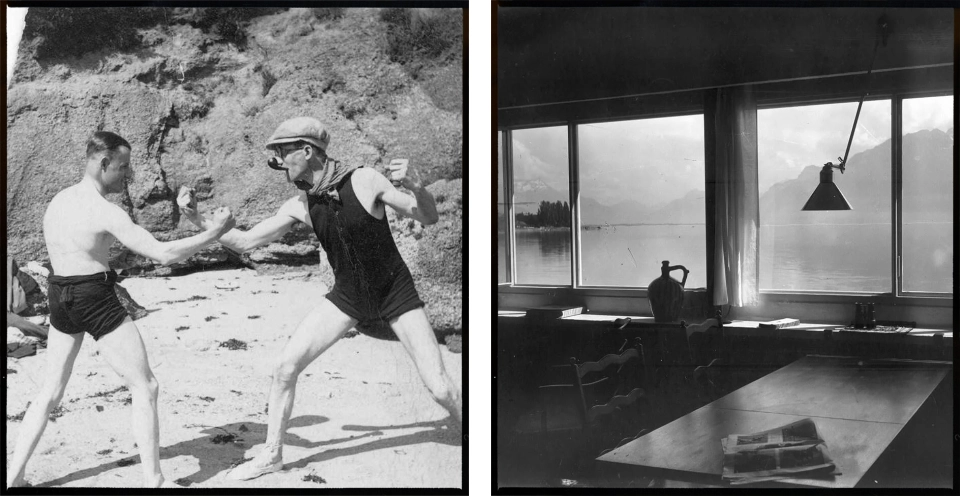
<p style="margin:0 0 9.5px;line-height:1.44">Pierre Jeanneret was born on 22 March 1896 in Geneva, the son of a physician.[1] His second cousin Charles-Édouard Jeanneret, who adopted the name Le Corbusier in 1920, was nine years older and would exert a decisive influence on Pierre’s professional trajectory. Pierre studied from 1913, interrupted by military service, at the École des Beaux-Arts in Geneva. In 1920 he moved to Paris, where he worked in the office of the Perret brothers until 1923.[2] This experience under Auguste and Gustave Perret, pioneers of reinforced concrete construction, proved formative for his later work.</p>
<p style="margin:0 0 4px"><img decoding="async" class="alignnone wp-image-11037 size-full" src="https://www.jeanneret-chandigarh.com/wp-content/uploads/2025/12/corbusier-jeanneret-villa-le-lac.webp" alt="le-corbusier-and-jeanneret-villa-le-lac-interior" width="960" height="496" srcset="https://www.jeanneret-chandigarh.com/wp-content/uploads/2025/12/corbusier-jeanneret-villa-le-lac.webp 960w, https://www.jeanneret-chandigarh.com/wp-content/uploads/2025/12/corbusier-jeanneret-villa-le-lac-300x155.webp 300w, https://www.jeanneret-chandigarh.com/wp-content/uploads/2025/12/corbusier-jeanneret-villa-le-lac-662x342.webp 662w, https://www.jeanneret-chandigarh.com/wp-content/uploads/2025/12/corbusier-jeanneret-villa-le-lac-768x397.webp 768w, https://www.jeanneret-chandigarh.com/wp-content/uploads/2025/12/corbusier-jeanneret-villa-le-lac-720x372.webp 720w, https://www.jeanneret-chandigarh.com/wp-content/uploads/2025/12/corbusier-jeanneret-villa-le-lac-323x167.webp 323w, https://www.jeanneret-chandigarh.com/wp-content/uploads/2025/12/corbusier-jeanneret-villa-le-lac-168x87.webp 168w, https://www.jeanneret-chandigarh.com/wp-content/uploads/2025/12/corbusier-jeanneret-villa-le-lac-240x124.webp 240w, https://www.jeanneret-chandigarh.com/wp-content/uploads/2025/12/corbusier-jeanneret-villa-le-lac-416x215.webp 416w, https://www.jeanneret-chandigarh.com/wp-content/uploads/2025/12/corbusier-jeanneret-villa-le-lac-445x230.webp 445w, https://www.jeanneret-chandigarh.com/wp-content/uploads/2025/12/corbusier-jeanneret-villa-le-lac-610x315.webp 610w" sizes="(max-width: 480px) 300, (max-width: 768px) 500px, (max-width: 1200px) 662px, 960px" /></p>
<div style="display:grid;grid-template-columns:1fr 1fr;column-gap:20px;max-width:960px;margin-bottom:1.5em"><span>Le Corbusier and Pierre Jeanneret on a beach in Piquey, 1933</span><span>Villa Le Lac by Le Corbusier and Pierre Jeanneret, interior</span></div>
<p style="margin:26px 0 7px;line-height:1.44"><u><em>THE PARTNERSHIP WITH LE CORBUSIER (1922-1940)</em></u></p>
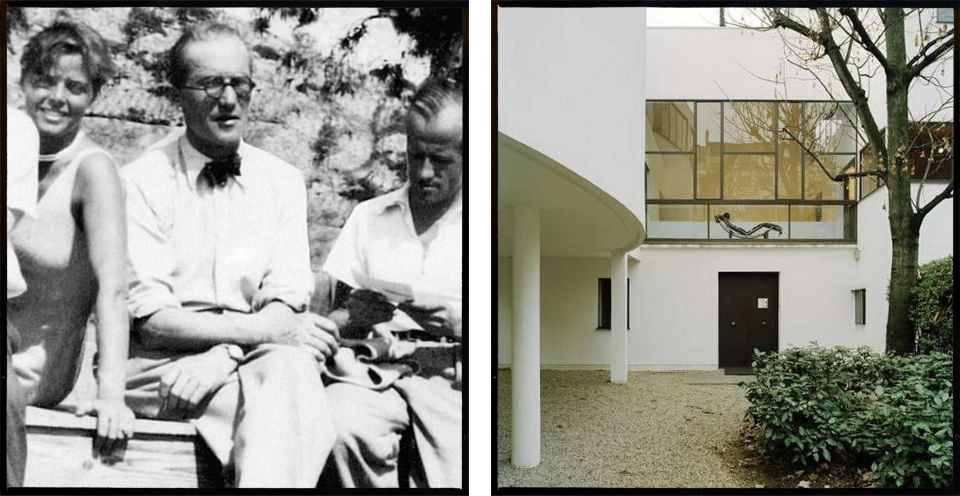
<p style="margin:0 0 9.5px;line-height:1.44">From 1921, while still employed by the Perret brothers, he worked on Le Corbusier’s first commissions. In 1922 they founded an office together.[3] This collaboration proved exceptionally productive and led to the realisation of some of the most significant buildings of classical modernism. Although Le Corbusier was often perceived as the sole author of their joint projects, Pierre Jeanneret was a partner and co-signatory, contributing both conceptually and practically to the development and execution of the designs. The two shared research interests and design principles within a close working relationship, interrupted in 1940 and resumed in 1951. In 1927 Le Corbusier and Pierre Jeanneret published the ‘Five Points of a New Architecture’ (Les 5 points d’une architecture nouvelle),[4] which became cornerstones of the modern movement: pilotis, the roof garden, the free plan, the horizontal window and the free façade.</p>
<p style="margin:0 0 9.5px;line-height:1.44">During the eighteen years of their partnership they realised numerous pioneering projects that became icons of modern architecture. Among the most notable joint works are:</p>
<ul style="list-style-type:'\2013\2002\2009';padding-left:21px;margin:0 0 23px 0">
<li style="margin:0 0 4px;line-height:1.44">Maison-atelier Ozenfant, Paris (1922-1924): an experimental building type combining dwelling and studio in a compact structure.</li>
<li style="margin:0 0 4px;line-height:1.44">Villa Le Lac, Corseaux (1923-1924): a compact house with a refined interior, built for Le Corbusier’s parents.</li>
<li style="margin:0 0 4px;line-height:1.44">Maisons La Roche-Jeanneret, Paris (1923-1925): a masterpiece distinguished by its ‘promenade architecturale’.[5]</li>
<li style="margin:0 0 4px;line-height:1.44">Pavillon de l’Esprit Nouveau (1925): a counter-proposal to the dominant Art Deco, presented at the Exposition internationale des arts décoratifs et industriels modernes.</li>
<li style="margin:0 0 4px;line-height:1.44">Maison Cook, Boulogne-sur-Seine (1926-1927): an innovative urban house with characteristic pilotis construction.</li>
<li style="margin:0 0 4px;line-height:1.44">Maison Guiette, Antwerp (1926-1927): an early example of their principles in Belgium.</li>
<li style="margin:0 0 4px;line-height:1.44">Weissenhof Estate, Stuttgart (1927): a single house and a semi-detached pair exemplifying their architectural principles.</li>
<li style="margin:0 0 4px;line-height:1.44">Villa Savoye, Poissy (1928-1931): regarded as the consummate manifesto of modern architecture and the culmination of their purist phase.</li>
<li style="margin:0 0 4px;line-height:1.44">Villa Baizeau, Carthage near Tunis (1928-1930): demonstrating the adaptation of modernist principles to a Mediterranean climate.</li>
</ul>
<p style="margin:0 0 9.5px;line-height:1.44">Further important projects included the Cité Frugès in Pessac near Bordeaux (1924-1927), an ambitious social housing project of around fifty houses, and the Pavillon Suisse at the Cité internationale universitaire in Paris (1930-1933). Their activities also extended to urban planning. The office’s orbit produced visionary schemes such as the Ville contemporaine for three million inhabitants (1922) and the Plan Voisin for Paris (1925), which provoked controversial debates about the future of the city. In 1926-1927 they took part in the competition for the Palace of the League of Nations in Geneva. While Le Corbusier dominated the theoretical articulation and public presentation of their work, Pierre Jeanneret was integral to the entire design and realisation process. His expertise in construction and detailing was as crucial as his formal contributions. This division of labour was characteristic of their collaboration and partly explains why Jeanneret’s role was long underestimated.</p>
<p style="margin:0 0 4px"><img decoding="async" class="alignnone wp-image-11039 size-full" src="https://www.jeanneret-chandigarh.com/wp-content/uploads/2025/12/corbusier-perriand-jeanneret-lc-chaise-longue.webp" alt="perriand-le-corbusier-jeanneret-villa-la-roche" width="960" height="496" srcset="https://www.jeanneret-chandigarh.com/wp-content/uploads/2025/12/corbusier-perriand-jeanneret-lc-chaise-longue.webp 960w, https://www.jeanneret-chandigarh.com/wp-content/uploads/2025/12/corbusier-perriand-jeanneret-lc-chaise-longue-300x155.webp 300w, https://www.jeanneret-chandigarh.com/wp-content/uploads/2025/12/corbusier-perriand-jeanneret-lc-chaise-longue-662x342.webp 662w, https://www.jeanneret-chandigarh.com/wp-content/uploads/2025/12/corbusier-perriand-jeanneret-lc-chaise-longue-768x397.webp 768w, https://www.jeanneret-chandigarh.com/wp-content/uploads/2025/12/corbusier-perriand-jeanneret-lc-chaise-longue-720x372.webp 720w, https://www.jeanneret-chandigarh.com/wp-content/uploads/2025/12/corbusier-perriand-jeanneret-lc-chaise-longue-323x167.webp 323w, https://www.jeanneret-chandigarh.com/wp-content/uploads/2025/12/corbusier-perriand-jeanneret-lc-chaise-longue-168x87.webp 168w, https://www.jeanneret-chandigarh.com/wp-content/uploads/2025/12/corbusier-perriand-jeanneret-lc-chaise-longue-240x124.webp 240w, https://www.jeanneret-chandigarh.com/wp-content/uploads/2025/12/corbusier-perriand-jeanneret-lc-chaise-longue-416x215.webp 416w, https://www.jeanneret-chandigarh.com/wp-content/uploads/2025/12/corbusier-perriand-jeanneret-lc-chaise-longue-445x230.webp 445w, https://www.jeanneret-chandigarh.com/wp-content/uploads/2025/12/corbusier-perriand-jeanneret-lc-chaise-longue-610x315.webp 610w" sizes="(max-width: 480px) 300, (max-width: 768px) 500px, (max-width: 1200px) 662px, 960px" /></p>
<div style="display:grid;grid-template-columns:1fr 1fr;column-gap:20px;max-width:960px;margin-bottom:1.5em"><span>Charlotte Perriand, Le Corbusier and Pierre Jeanneret</span><span>Maison La Roche with the chaise longue by Le Corbusier, Pierre Jeanneret and Charlotte Perriand</span></div>
<p style="margin:26px 0 7px;line-height:1.44"><u><em>FURNITURE DESIGN AND THE COLLABORATION WITH CHARLOTTE PERRIAND</em></u></p>
<p style="margin:0 0 9.5px;line-height:1.44">Another essential aspect of Pierre Jeanneret’s work is his contribution to furniture design. From October 1927 the office collaborated with the designer Charlotte Perriand, resulting in a series of iconic furniture designs. Among the best known are the Fauteuil à dossier basculant (LC1), the Fauteuil Grand confort (LC2) and the Chaise longue à réglage continu (LC4), all of 1928,[6] now regarded as joint works by Le Corbusier, Pierre Jeanneret and Charlotte Perriand.</p>
<p style="margin:0 0 9.5px;line-height:1.44">These pieces represented a radical departure from traditional furnishing concepts. They employed modern materials such as chrome-plated tubular steel. The furniture was not conceived as decorative objects but as ‘équipement intérieur de l’habitation’, equipment for modern living, combining comfort with an industrial aesthetic.</p>
<p style="margin:0 0 9.5px;line-height:1.44">The collaboration with Perriand was especially productive and led to a redefinition of modern furniture design. While Le Corbusier often set the conceptual direction, it was Jeanneret and Perriand who undertook the practical development and refinement of the designs. Shown in 1929 at the Salon d’Automne in Paris as the ensemble ‘Équipement intérieur d’une habitation’,[7] the furniture provoked debate. It marked a turning point in European furniture design and influenced generations of designers.</p>
<p style="margin:0 0 4px"><img loading="lazy" decoding="async" class="alignnone wp-image-11041 size-full" src="https://www.jeanneret-chandigarh.com/wp-content/uploads/2025/12/perriand-prouve-bcc-8-8-bookcase.webp" alt="perriand-bookcase-prouve-greenoble-8-8-bcc" width="960" height="496" srcset="https://www.jeanneret-chandigarh.com/wp-content/uploads/2025/12/perriand-prouve-bcc-8-8-bookcase.webp 960w, https://www.jeanneret-chandigarh.com/wp-content/uploads/2025/12/perriand-prouve-bcc-8-8-bookcase-300x155.webp 300w, https://www.jeanneret-chandigarh.com/wp-content/uploads/2025/12/perriand-prouve-bcc-8-8-bookcase-662x342.webp 662w, https://www.jeanneret-chandigarh.com/wp-content/uploads/2025/12/perriand-prouve-bcc-8-8-bookcase-768x397.webp 768w, https://www.jeanneret-chandigarh.com/wp-content/uploads/2025/12/perriand-prouve-bcc-8-8-bookcase-720x372.webp 720w, https://www.jeanneret-chandigarh.com/wp-content/uploads/2025/12/perriand-prouve-bcc-8-8-bookcase-323x167.webp 323w, https://www.jeanneret-chandigarh.com/wp-content/uploads/2025/12/perriand-prouve-bcc-8-8-bookcase-168x87.webp 168w, https://www.jeanneret-chandigarh.com/wp-content/uploads/2025/12/perriand-prouve-bcc-8-8-bookcase-240x124.webp 240w, https://www.jeanneret-chandigarh.com/wp-content/uploads/2025/12/perriand-prouve-bcc-8-8-bookcase-416x215.webp 416w, https://www.jeanneret-chandigarh.com/wp-content/uploads/2025/12/perriand-prouve-bcc-8-8-bookcase-445x230.webp 445w, https://www.jeanneret-chandigarh.com/wp-content/uploads/2025/12/perriand-prouve-bcc-8-8-bookcase-610x315.webp 610w" sizes="auto, (max-width: 480px) 300, (max-width: 768px) 500px, (max-width: 1200px) 662px, 960px" /></p>
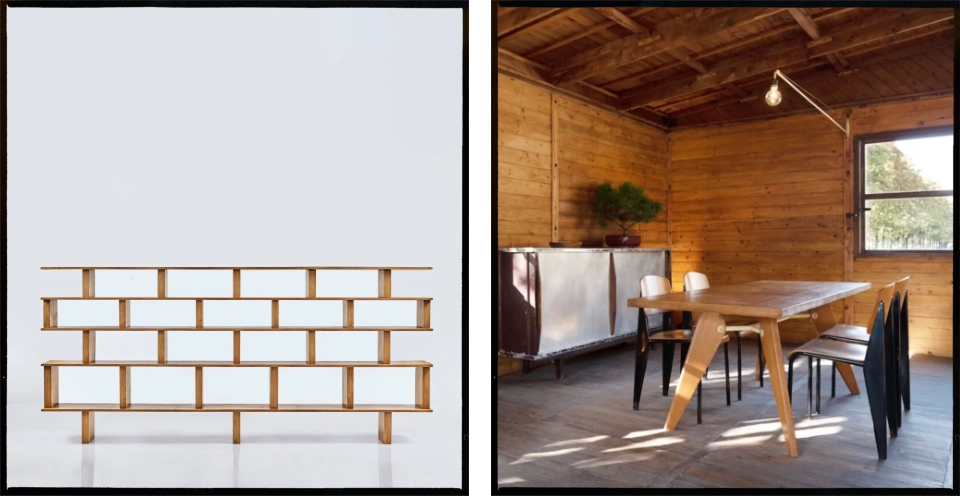
<div style="display:grid;grid-template-columns:1fr 1fr;column-gap:20px;max-width:960px;margin-bottom:1.5em"><span>Bookcase by Perriand and Jeanneret</span><span>Interior of an F 8×8 BCC demountable house by Jean Prouvé and Pierre Jeanneret</span></div>
<p style="margin:26px 0 7px;line-height:1.44"><u><em>THE YEARS IN GRENOBLE AND THE BCC (1940-1952)</em></u></p>
<p style="margin:0 0 9.5px;line-height:1.44">After the end of the partnership with Le Corbusier in 1940, which also reflected political divergence (from 1941 Le Corbusier sought commissions from the Vichy regime), Pierre Jeanneret settled in Grenoble at the end of 1940. As early as 1939, together with Charlotte Perriand, Jean Prouvé and the journalist, sports official and entrepreneur Georges Blanchon, he had worked on demountable pavilions for the SCAL aluminium works at Issoire. In October 1940 Blanchon founded the Bureau Central de Construction (BCC) in Grenoble, which Jeanneret joined in December; the firm developed prefabricated, low-cost and demountable building systems.[8] Perriand herself had left for Japan in 1940 and did not return to France until 1946.</p>
<p style="margin:0 0 9.5px;line-height:1.44">During the Second World War Jeanneret was actively involved in the French Resistance under the code name ‘Guidondevélo’; according to Charlotte Perriand, he carried messages hidden in the handlebars of his bicycle.[9] Georges Blanchon fought in the Resistance as well, and Jean Prouvé was active in Nancy. At the same time, the BCC advanced pioneering projects in lightweight prefabrication and demountable housing, such as the F 8×8 BCC houses at Saint-Auban (1942).[10] They rank among the most formative contributions to French building research of those years. The BCC was dissolved in 1952.</p>
<p style="margin:0 0 4px"><img loading="lazy" decoding="async" class="alignnone wp-image-11042 size-full" src="https://www.jeanneret-chandigarh.com/wp-content/uploads/2025/12/chandigarh-project-india-historic.webp" alt="jeanneret-on-a-bicycle-chandigarh-secretariat-building" width="960" height="496" srcset="https://www.jeanneret-chandigarh.com/wp-content/uploads/2025/12/chandigarh-project-india-historic.webp 960w, https://www.jeanneret-chandigarh.com/wp-content/uploads/2025/12/chandigarh-project-india-historic-300x155.webp 300w, https://www.jeanneret-chandigarh.com/wp-content/uploads/2025/12/chandigarh-project-india-historic-662x342.webp 662w, https://www.jeanneret-chandigarh.com/wp-content/uploads/2025/12/chandigarh-project-india-historic-768x397.webp 768w, https://www.jeanneret-chandigarh.com/wp-content/uploads/2025/12/chandigarh-project-india-historic-720x372.webp 720w, https://www.jeanneret-chandigarh.com/wp-content/uploads/2025/12/chandigarh-project-india-historic-323x167.webp 323w, https://www.jeanneret-chandigarh.com/wp-content/uploads/2025/12/chandigarh-project-india-historic-168x87.webp 168w, https://www.jeanneret-chandigarh.com/wp-content/uploads/2025/12/chandigarh-project-india-historic-240x124.webp 240w, https://www.jeanneret-chandigarh.com/wp-content/uploads/2025/12/chandigarh-project-india-historic-416x215.webp 416w, https://www.jeanneret-chandigarh.com/wp-content/uploads/2025/12/chandigarh-project-india-historic-445x230.webp 445w, https://www.jeanneret-chandigarh.com/wp-content/uploads/2025/12/chandigarh-project-india-historic-610x315.webp 610w" sizes="auto, (max-width: 480px) 300, (max-width: 768px) 500px, (max-width: 1200px) 662px, 960px" /></p>
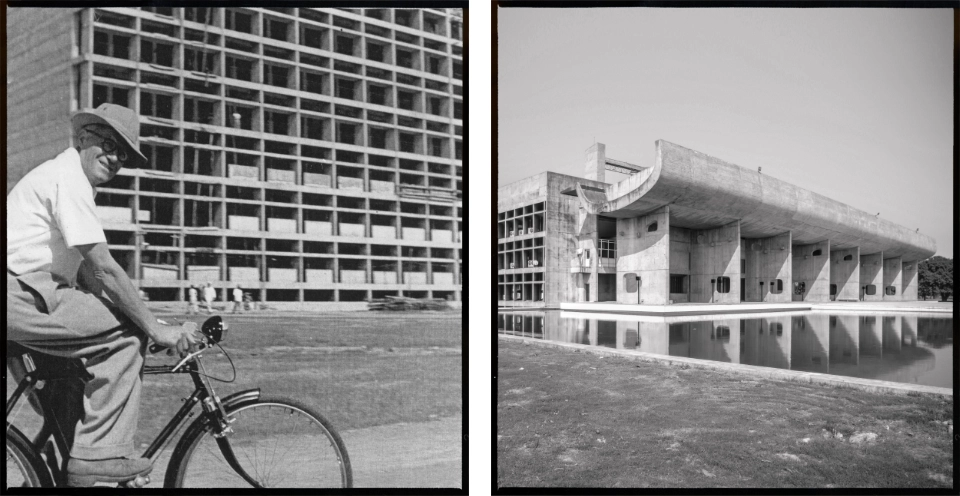
<div style="display:grid;grid-template-columns:1fr 1fr;column-gap:20px;max-width:960px;margin-bottom:1.5em"><span>Pierre Jeanneret visits the construction site of the Secretariat in Chandigarh</span><span>Palace of Assembly, Chandigarh</span></div>
<p style="margin:26px 0 7px;line-height:1.44"><u><em>THE CHANDIGARH PROJECT FROM 1951</em></u></p>
<p style="margin:0 0 9.5px;line-height:1.44">Another transformation in Pierre Jeanneret’s career came after 1950. Following the partition of India in 1947, the state of Punjab lost its capital Lahore, which became part of Pakistan. The Indian government under Prime Minister Jawaharlal Nehru decided to build a new capital, Chandigarh, as a symbol of a modern, independent India. In 1951 Le Corbusier took over the planning, begun by Albert Mayer and Matthew Nowicki, and brought in Pierre Jeanneret, together with Maxwell Fry and Jane Drew.[11]</p>
<p style="margin:0 0 9.5px;line-height:1.44">Le Corbusier built the Capitol in concrete: monumental and expressive, the image of the state. He came twice a year. Jeanneret stayed in Chandigarh from 1951 to 1965 and later became chief architect. Beyond the Capitol, he designed much of the city: schools, hospitals, administrative buildings, Panjab University, housing.</p>
<p style="margin:0 0 9.5px;line-height:1.44">He rarely sought boldness. Where he did, in the Gandhi Bhawan at Panjab University, he entered Le Corbusier’s sculptural territory without reaching the same complexity. His stronger work lies in the housing and the schools. They respond to the climate of northern India: extreme summer heat, the monsoon. Sunshades, deep verandas, perforated brick screens and cross-ventilation keep out sun and heat. With Fry and Drew he developed affordable housing types for different income groups. They start from Indian ways of living and family structures and take up traditional elements such as the veranda. Young Indian architects worked on them, among them Aditya Prakash, M. N. Sharma and Eulie Chowdhury.[12] They were built in local brick and concrete, by local craftsmen.</p>
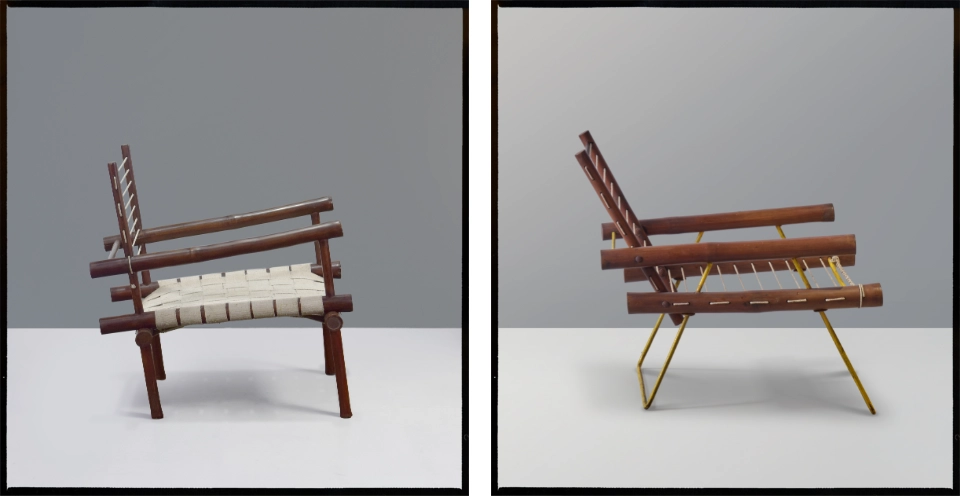
<p style="margin:0 0 4px"><span class="pg-imgmap" style="position:relative;display:inline-block;line-height:0"><img loading="lazy" decoding="async" class="alignnone wp-image-11043 size-full" src="https://www.jeanneret-chandigarh.com/wp-content/uploads/2025/12/chandigarh-furniture-bamboo-cotton.webp" alt="pj-si-01-c-and-pj-si-04-a-bamboo-chairs-jeanneret" width="960" height="496" srcset="https://www.jeanneret-chandigarh.com/wp-content/uploads/2025/12/chandigarh-furniture-bamboo-cotton.webp 960w, https://www.jeanneret-chandigarh.com/wp-content/uploads/2025/12/chandigarh-furniture-bamboo-cotton-300x155.webp 300w, https://www.jeanneret-chandigarh.com/wp-content/uploads/2025/12/chandigarh-furniture-bamboo-cotton-662x342.webp 662w, https://www.jeanneret-chandigarh.com/wp-content/uploads/2025/12/chandigarh-furniture-bamboo-cotton-768x397.webp 768w, https://www.jeanneret-chandigarh.com/wp-content/uploads/2025/12/chandigarh-furniture-bamboo-cotton-720x372.webp 720w, https://www.jeanneret-chandigarh.com/wp-content/uploads/2025/12/chandigarh-furniture-bamboo-cotton-323x167.webp 323w, https://www.jeanneret-chandigarh.com/wp-content/uploads/2025/12/chandigarh-furniture-bamboo-cotton-168x87.webp 168w, https://www.jeanneret-chandigarh.com/wp-content/uploads/2025/12/chandigarh-furniture-bamboo-cotton-240x124.webp 240w, https://www.jeanneret-chandigarh.com/wp-content/uploads/2025/12/chandigarh-furniture-bamboo-cotton-416x215.webp 416w, https://www.jeanneret-chandigarh.com/wp-content/uploads/2025/12/chandigarh-furniture-bamboo-cotton-445x230.webp 445w, https://www.jeanneret-chandigarh.com/wp-content/uploads/2025/12/chandigarh-furniture-bamboo-cotton-610x315.webp 610w" sizes="auto, (max-width: 480px) 300, (max-width: 768px) 500px, (max-width: 1200px) 662px, 960px" /><a href="https://www.jeanneret-chandigarh.com/en/portfolio/pj-si-01-c" aria-label="PJ-SI-01-C" style="position:absolute;top:0;left:0;width:50%;height:100%"></a><a href="https://www.jeanneret-chandigarh.com/en/portfolio/pj-si-04-a" aria-label="PJ-SI-04-A" style="position:absolute;top:0;right:0;width:50%;height:100%"></a></span></p>
<div style="display:grid;grid-template-columns:1fr 1fr;column-gap:20px;max-width:960px;margin-bottom:1.5em"><span>Armchair PJ-SI-01-C by Jeanneret</span><span>Armchair PJ-SI-04-A by Jeanneret</span></div>
<p style="margin:26px 0 7px;line-height:1.44"><u><em>THE CHANDIGARH FURNITURE</em></u></p>
<p style="margin:0 0 5px;line-height:1.44">A) EXPERIMENTAL PHASE</p>
<p style="margin:0 0 9.5px;line-height:1.44"><a href="https://www.jeanneret-chandigarh.com/en/chandigarh">Jeanneret’s furniture for Chandigarh</a> differs both from his earlier work and from other tendencies of regionalist modernism. The early pieces, particularly the seating up to 1955 (catalogued by Touchaleaume and Moreau as PJ-SI-01 to PJ-SI-12),[13] display a wild, almost childlike urge to experiment. Chairs were constructed from bamboo, rope, metal frames, cane or chains, and were demountable. It appears as though Jeanneret created a free field in which he cast aside dogma, professionalism and the stylistic imperatives of modernism.</p>
<p style="margin:0 0 9.5px;line-height:1.44">The chair PJ-SI-07-A, whose seat hangs from the armrests by chains, is a striking example. Many of these objects were easy to produce: bamboo lashed together with a few ropes or other improvised constructions. Frames carry light seats and backs. The contrast between what carries and what is carried emphasises the constructive logic and lends the objects a raw, almost sculptural quality. Yet many of these early designs were too fragile for everyday use; they remained prototypes, records of Jeanneret’s unrestrained creative drive.</p>
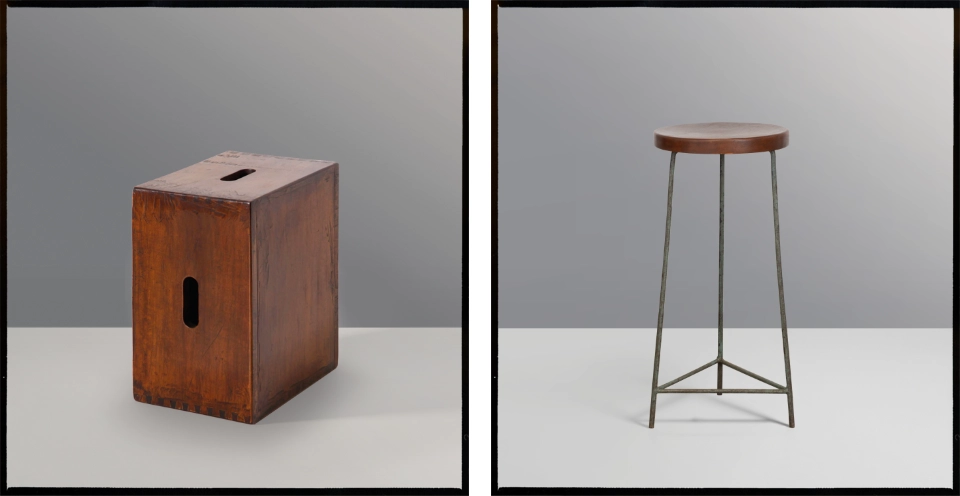
<p style="margin:0 0 4px"><span class="pg-imgmap" style="position:relative;display:inline-block;line-height:0"><img loading="lazy" decoding="async" class="alignnone wp-image-11044 size-full" src="https://www.jeanneret-chandigarh.com/wp-content/uploads/2025/12/le-corbusier-cabanon-stool-chandigarh.webp" alt="lc-14-a-stool-and-pj-si-58-a-metal-legged-stool" width="960" height="496" srcset="https://www.jeanneret-chandigarh.com/wp-content/uploads/2025/12/le-corbusier-cabanon-stool-chandigarh.webp 960w, https://www.jeanneret-chandigarh.com/wp-content/uploads/2025/12/le-corbusier-cabanon-stool-chandigarh-300x155.webp 300w, https://www.jeanneret-chandigarh.com/wp-content/uploads/2025/12/le-corbusier-cabanon-stool-chandigarh-662x342.webp 662w, https://www.jeanneret-chandigarh.com/wp-content/uploads/2025/12/le-corbusier-cabanon-stool-chandigarh-768x397.webp 768w, https://www.jeanneret-chandigarh.com/wp-content/uploads/2025/12/le-corbusier-cabanon-stool-chandigarh-720x372.webp 720w, https://www.jeanneret-chandigarh.com/wp-content/uploads/2025/12/le-corbusier-cabanon-stool-chandigarh-323x167.webp 323w, https://www.jeanneret-chandigarh.com/wp-content/uploads/2025/12/le-corbusier-cabanon-stool-chandigarh-168x87.webp 168w, https://www.jeanneret-chandigarh.com/wp-content/uploads/2025/12/le-corbusier-cabanon-stool-chandigarh-240x124.webp 240w, https://www.jeanneret-chandigarh.com/wp-content/uploads/2025/12/le-corbusier-cabanon-stool-chandigarh-416x215.webp 416w, https://www.jeanneret-chandigarh.com/wp-content/uploads/2025/12/le-corbusier-cabanon-stool-chandigarh-445x230.webp 445w, https://www.jeanneret-chandigarh.com/wp-content/uploads/2025/12/le-corbusier-cabanon-stool-chandigarh-610x315.webp 610w" sizes="auto, (max-width: 480px) 300, (max-width: 768px) 500px, (max-width: 1200px) 662px, 960px" /><a href="https://www.jeanneret-chandigarh.com/en/portfolio/le-corbusier-lc-14" aria-label="LC-14" style="position:absolute;top:0;left:0;width:50%;height:100%"></a><a href="https://www.jeanneret-chandigarh.com/en/portfolio/high-metal-stool" aria-label="PJ-SI-58-A" style="position:absolute;top:0;right:0;width:50%;height:100%"></a></span></p>
<div style="display:grid;grid-template-columns:1fr 1fr;column-gap:20px;max-width:960px;margin-bottom:1.5em"><span>Tabouret Cabanon (later LC14) by Le Corbusier</span><span>Stool PJ-SI-58-A by Jeanneret</span></div>
<p style="margin:19px 0 5px;line-height:1.44">B) ARCHETYPAL DESIGN</p>
<p style="margin:0 0 9.5px;line-height:1.44">A more unified formal language soon emerged. It allowed an entire city to be furnished with types that local craftsmen could produce from available materials. Teak or sissoo members, assembled into A-, X-, Z- or bridge-like forms, constitute the structure and grammar of most pieces. The result is direct and unforced. The best-known of these types is the <a href="https://www.jeanneret-chandigarh.com/en/pierre-jeanneret-chair">Chandigarh chair</a>. Did Pierre Jeanneret recognise in non-design the highest form of design, a form in which the poetry of the everyday takes precedence over ambitious formal compulsion? The forms are plain, almost banal. Were it not for the small refinements: certain edges rounded, members tapering towards their ends, fixings concealed, and particular attention paid to proportion.</p>
<p style="margin:0 0 9.5px;line-height:1.44">India was a liberation for Pierre Jeanneret. Everyday life became the measure. The same tendency appears at the same time in Le Corbusier’s work: archaic furniture types come into focus. In 1952 Le Corbusier developed a stool for his Cabanon at Roquebrune-Cap-Martin that was nothing more than a box,[14] and in 1953 a stool for his projects in Ahmedabad consisting of a steel tube and a plain seat.</p>
<p style="margin:0 0 9.5px;line-height:1.44">Although functional and pragmatic aspects always played a role in Pierre Jeanneret’s Chandigarh project, this should not be described as functional design. The aim was to reach the fundamental with everyday means. Both Pierre Jeanneret and Le Corbusier were searching for it, and the poetic was always part of it. In Jeanneret’s case this was more pragmatic and closer to people; in Le Corbusier’s work an additional spiritual and visionary dimension emerged.</p>
<p style="margin:0 0 9.5px;line-height:1.44"><a href="https://www.jeanneret-chandigarh.com/en/pierre-jeanneret-certified-authentic-dining-chairs-p-galerie">Pierre Jeanneret</a> returned to Switzerland in poor health in 1965 after fourteen years and died on 4 December 1967 in Thônex near Geneva.[1]</p>
<p style="margin:0 0 43px;font-size:11px;line-height:1.25;color:#555">Photographs © Canadian Centre for Architecture; © FLC/ADAGP; © Sotheby’s; © Galerie Patrick Seguin; © Olivier Martin Gambier.</p>
<p style="margin:2.5em 0 0 0"><u>NOTES</u></p>
<p style="margin:0">[1] <em>Historisches Lexikon der Schweiz</em>, s.v. ‘Jeanneret, Pierre’, version of 25 September 2006, https://hls-dhs-dss.ch/de/articles/043068/2006-09-25/.</p>
<p style="margin:0">[2] Michel D’hoe, ‘Invisibility in Archives and History: Reflections on the Reception of Pierre Jeanneret’s Work’, <em>CLARA</em> 9 (2024), pp. 142-143, citing the Perret brothers’ employment records (May 1920 to May 1923). The HLS gives 1921 as the start of his Paris activity.</p>
<p style="margin:0">[3] Ibid.; first joint commission: Maison Berque project, Paris, 1921. On the office 1922-1940: <em>Historisches Lexikon der Schweiz</em> (see n. 1).</p>
<p style="margin:0">[4] Alfred Roth, <em>Zwei Wohnhäuser von Le Corbusier und Pierre Jeanneret</em>, with <em>Fünf Punkte zu einer neuen Architektur</em> by Le Corbusier and Pierre Jeanneret, foreword by Hans Hildebrandt (Stuttgart: Fr. Wedekind, 1927).</p>
<p style="margin:0">[5] ‘Jeanneret’ here refers to Albert Jeanneret, musician and brother of Le Corbusier, client for the second half of the house, not to Pierre Jeanneret.</p>
<p style="margin:0">[6] Charlotte Perriand, <em>Une vie de création</em> (Paris: Odile Jacob, 1998). The designations LC1, LC2 and LC4 derive from the Cassina edition from 1965 and are anachronistic for 1928.</p>
<p style="margin:0">[7] Ibid.</p>
<p style="margin:0">[8] Christophe Laurent, ‘Les pavillons préfabriqués et équipés de Pierre Jeanneret, Jean Prouvé et Charlotte Perriand pour la Société centrale des alliages légers, Issoire, 1939-1941’, <em>Recherches en histoire de l’art</em>, no. 1 (2002), pp. 33, 54; Daniel Sage, <em>Georges Blanchon, cet homme protée libre et généreux</em> (Grenoble: La Glisse, 2023).</p>
<p style="margin:0">[9] Perriand, <em>Une vie de création</em> (see n. 6), p. 220; Xavier de Jarcy, <em>Le Corbusier, un fascisme français</em> (Paris: Albin Michel, 2015), p. 202.</p>
<p style="margin:0">[10] Canadian Centre for Architecture, Pierre Jeanneret fonds, file ‘Maisons Bureau Central de Constructions, Saint-Auban’, 1942.</p>
<p style="margin:0">[11] Kiran Joshi, <em>Documenting Chandigarh: The Indian Architecture of Pierre Jeanneret, Edwin Maxwell Fry, Jane Beverly Drew</em>, vol. 1 (Ahmedabad: Mapin, 1999).</p>
<p style="margin:0">[12] Ibid.</p>
<p style="margin:0">[13] Eric Touchaleaume and Gérald Moreau, <em>Le Corbusier, Pierre Jeanneret: The Indian Adventure. Design, Art, Architecture</em> (Montreuil: Gourcuff Gradenigo, 2010).</p>
<p style="margin:0">[14] ‘LC14’ is the later Cassina designation.</p>
</div>
<p>The post <a href="https://www.jeanneret-chandigarh.com/en/chandigarh-jeanneret-history-life-perriand-prouve">Pierre Jeanneret: The Transformation and the Classification of His Work</a> appeared first on <a href="https://www.jeanneret-chandigarh.com/en/pierre-jeanneret-chair">P! Galerie</a>.</p>
]]></content>
		
			</entry>
		<entry>
		<author>
			<name>Pedja Hadzimanovic</name>
							<uri>https://www.jeanneret-chandigarh.com</uri>
						</author>

		<title type="html"><![CDATA[Why Blockchain Certificates for Design Objects]]></title>
		<link rel="alternate" type="text/html" href="https://www.jeanneret-chandigarh.com/en/why-blockchain-certificates-for-your-design-objects" />

		<id>https://www.jeanneret-chandigarh.com/?p=10845</id>
		<updated>2026-11-25T01:11:29Z</updated>
		<published>2025-12-12T11:49:08Z</published>
		<category scheme="https://www.jeanneret-chandigarh.com/en/pierre-jeanneret-chair" term="Uncategorized" />
		<summary type="html"><![CDATA[<p>A blockchain certificate is an authenticity certificate for a design object.1 It...</p>
<p>The post <a href="https://www.jeanneret-chandigarh.com/en/why-blockchain-certificates-for-your-design-objects">Why Blockchain Certificates for Design Objects</a> appeared first on <a href="https://www.jeanneret-chandigarh.com/en/pierre-jeanneret-chair">P! Galerie</a>.</p>
]]></summary>

					<content type="html" xml:base="https://www.jeanneret-chandigarh.com/en/why-blockchain-certificates-for-your-design-objects"><![CDATA[<style>.single-post-page-10845 h1 + div{margin-left:clamp(1em,6vw,5.6em);text-align:left !important}</style>
<p style="margin-left:clamp(1em,6vw,5.6em)">A blockchain certificate is an authenticity certificate for a design object.<sup><a href="#note-1" id="ref-1">1</a></sup> It can be verified at any time and from anywhere, and a later change to the information is detectable.<sup><a href="#note-2" id="ref-2">2</a></sup> Many physical certificates of design objects today carry no photographs, or the attached photos are too small to establish that the certificate belongs to a specific item. In addition, the colours of photos fade and information can be manipulated by hand, so certainty decreases over time. Certainty is the main function of a certificate: clear evidence over the long term. Purely physical certificates remain provable only as long as the selling gallery exists; after that, verification becomes difficult. This leads to losses in value and to difficulties for later owners and descendants.</p>
<div class="more"></div>
<p><span id="more-10845"></span></p>
<div class="postnewsleft">
<p style="margin-left:clamp(1em,6vw,5.6em)">Blockchain certificates are therefore a response to a market problem, particularly evident in Chandigarh design. The buyer receives a physical certificate with a link, the issuing gallery has the certificate in its system, and it is additionally stored on a blockchain as a PDF document.</p>
<p style="margin:0">CHANDIGARH ITEMS AND DOCUMENTATION</p>
<p style="margin-left:clamp(1em,6vw,5.6em)">Chandigarh furniture was never sold in the conventional sense. It was distributed or auctioned off in bulk. Purchase receipts for individual pieces rarely exist. Provenance often relies exclusively on oral tradition, making these objects vulnerable to falsification. The situation is complicated further because purchase documents from India are relatively easy to forge and it cannot be excluded that employees of public institutions are bribed. At the same time, an object must have been acquired lawfully.</p>
<p style="margin-left:clamp(1em,6vw,5.6em)">On 22 February 2011 the Indian Ministry of Home Affairs, which administers the Union Territory of Chandigarh, issued an order that, according to press reports, prohibits the sale, disposal, removal and export of furniture designed by Pierre Jeanneret and Le Corbusier owned by the Chandigarh Administration and other public bodies in the city.<sup><a href="#note-3" id="ref-3">3</a></sup> Many pieces left public ownership through scrap sales by the administration in the late 1980s and early 1990s, long before the order, and passed to private owners.<sup><a href="#note-4" id="ref-4">4</a></sup> Objects removed after 2011 are treated by the Indian authorities as unlawfully removed.<sup><a href="#note-5" id="ref-5">5</a></sup> The date on which an object passed from public to private ownership therefore matters, and the certificate records it.</p>
<p style="margin:0">BLOCKCHAIN AS THE SOLUTION</p>
<p style="margin-left:clamp(1em,6vw,5.6em)">Blockchain technology enables digital provenance documentation in which a retroactive change is detectable. The record is stored permanently.<sup><a href="#note-2" id="ref-2b">2</a></sup> Even if the physical document is lost or the gallery dissolves, the certificate remains preserved and accessible. The blockchain secures the entry, not its content: the record is only as reliable as the data entered. The link between the physical object and the record is established by the issuing gallery: through its expertise, the examination of the object, photographs of identifying features and a condition report.<sup><a href="#note-6" id="ref-6">6</a></sup></p>
<p style="margin:0">WHAT IS DOCUMENTED</p>
<p style="margin-left:clamp(1em,6vw,5.6em)">A blockchain certificate contains documentation: the authenticity of the object, a condition report, photographs for identification, the restoration history, as well as the expertise and verification by the issuing gallery. The current change of ownership at the time of certification is recorded.</p>
<p style="margin:0">SECURING PROVENANCE FOR GENERATIONS</p>
<p style="margin-left:clamp(1em,6vw,5.6em)">The significance of these certificates becomes clear when objects are passed on to descendants or sold. In both cases, the reputation of the issuing gallery and the completeness of the documentation are decisive. Where objects are documented in this way, the market becomes more transparent and forgeries become easier to identify. Documented authenticity supports the value of an object.</p>
<p style="margin-left:clamp(1em,6vw,5.6em)">The certificate documents the object in a form that remains verifiable for later owners.</p>
<p style="margin:0">NOTES</p>
<p id="note-1" style="font-size:0.85em;margin-left:clamp(1em,6vw,5.6em)"><a href="#ref-1">1</a> Claudia Giannoni, Francesca Medda and Silvia Bartolucci, “Blockchain Technologies and Art: Opportunities and Open Challenges”, <i>SSRN Electronic Journal</i>, 2023, p. 7, <a href="https://doi.org/10.2139/ssrn.4439318">https://doi.org/10.2139/ssrn.4439318</a>.</p>
<p id="note-2" style="font-size:0.85em;margin-left:clamp(1em,6vw,5.6em)"><a href="#ref-2">2</a> Giannoni et al. (note 1), p. 3.</p>
<p id="note-3" style="font-size:0.85em;margin-left:clamp(1em,6vw,5.6em)"><a href="#ref-3">3</a> The Tribune, “10 heritage items sold for Rs 79.16 lakh in US”, 9 June 2023, <a href="https://www.tribuneindia.com/news/chandigarh/10-heritage-items-sold-for-rs-79-16-lakh-in-us-515505">https://www.tribuneindia.com/news/chandigarh/10-heritage-items-sold-for-rs-79-16-lakh-in-us-515505</a>. The order itself is not published; the reports rely mainly on Ajay Jagga, member of the Heritage Items Protection Cell of the Chandigarh Administration.</p>
<p id="note-4" style="font-size:0.85em;margin-left:clamp(1em,6vw,5.6em)"><a href="#ref-4">4</a> The Tribune, “Explainer: Why Chandigarh’s heritage furniture keeps selling abroad”, <a href="https://www.tribuneindia.com/news/explainers/explainer-why-chandigarhs-heritage-furniture-keep-selling-abroad/">https://www.tribuneindia.com/news/explainers/explainer-why-chandigarhs-heritage-furniture-keep-selling-abroad/</a>.</p>
<p id="note-5" style="font-size:0.85em;margin-left:clamp(1em,6vw,5.6em)"><a href="#ref-5">5</a> The Tribune, “Chandigarh’s heritage recovery: How UNIDROIT, UNESCO gave India the legal lever it never had”, <a href="https://www.tribuneindia.com/news/chandigarh/chandigarhs-heritage-recovery-how-unidroit-unesco-gave-india-the-legal-lever-it-never-had/">https://www.tribuneindia.com/news/chandigarh/chandigarhs-heritage-recovery-how-unidroit-unesco-gave-india-the-legal-lever-it-never-had/</a>.</p>
<p id="note-6" style="font-size:0.85em;margin-left:clamp(1em,6vw,5.6em)"><a href="#ref-6">6</a> Giannoni et al. (note 1), pp. 4, 8, 15.</p>
</div>
<p>The post <a href="https://www.jeanneret-chandigarh.com/en/why-blockchain-certificates-for-your-design-objects">Why Blockchain Certificates for Design Objects</a> appeared first on <a href="https://www.jeanneret-chandigarh.com/en/pierre-jeanneret-chair">P! Galerie</a>.</p>
]]></content>
		
			</entry>
		<entry>
		<author>
			<name>Pedja Hadzimanovic</name>
							<uri>https://www.jeanneret-chandigarh.com</uri>
						</author>

		<title type="html"><![CDATA[On the Authenticity of Historic Chandigarh Furniture]]></title>
		<link rel="alternate" type="text/html" href="https://www.jeanneret-chandigarh.com/en/why-authenticity-needs-extra-attention-when-buying-chandigarh-items" />

		<id>https://www.jeanneret-chandigarh.com/?p=10849</id>
		<updated>2026-11-25T01:14:53Z</updated>
		<published>2025-11-22T12:14:00Z</published>
		<category scheme="https://www.jeanneret-chandigarh.com/en/pierre-jeanneret-chair" term="Uncategorized" />
		<summary type="html"><![CDATA[<p>AUTHENTICITY With Chandigarh items, authenticity is essential. It concerns not only shape...</p>
<p>The post <a href="https://www.jeanneret-chandigarh.com/en/why-authenticity-needs-extra-attention-when-buying-chandigarh-items">On the Authenticity of Historic Chandigarh Furniture</a> appeared first on <a href="https://www.jeanneret-chandigarh.com/en/pierre-jeanneret-chair">P! Galerie</a>.</p>
]]></summary>

					<content type="html" xml:base="https://www.jeanneret-chandigarh.com/en/why-authenticity-needs-extra-attention-when-buying-chandigarh-items"><![CDATA[<style>.single-post-page-10849 h1 + div{margin-left:clamp(1em,6vw,5.6em);text-align:left !important}</style>
<p style="margin:0 0 0 clamp(1em,6vw,5.6em)">AUTHENTICITY</p>
<p style="margin-left:clamp(1em,6vw,5.6em)">With Chandigarh items, authenticity is essential. It concerns not only shape but history and value. Two questions follow: what must remain original, and which parts may be replaced? At P! Galerie all solid wooden parts of a piece are original to it. Damaged components are never replaced with new ones, and parts are never taken from other damaged pieces. Where the limits lie must be defined. Many items are damaged, and dealers draw these limits differently. Buyers should discuss the gallery’s policy before buying.</p>
<div class="more"></div>
<p><span id="more-10849"></span></p>
<div class="postnewsleft">
<p style="margin-left:clamp(1em,6vw,5.6em)">Veneer is a separate case and depends on the piece. The thin veneer is glued to plywood. It is more fragile and has often been replaced over the last seventy years. In the gallery’s experience, auction houses and established galleries accept a replaced veneer top as part of the Chandigarh reality, but many omit it from the certificate. The type of replacement should be documented there.</p>
<p style="margin-left:clamp(1em,6vw,5.6em)">Replacing cushions, cane, upholstery or foam is standard and does not affect value. Repainting metal parts is another matter, and opinions differ. P! Galerie does not repaint; other galleries are less strict. Pedja Hadži-Manović, gallery owner, says: “The richness, depth, and traces of use and time in the paint are essential to the item’s character, history and value. I consider repainted objects worthless.” Some buyers prefer a more presentable condition, and many galleries follow this wish and repaint.</p>
<p style="margin-left:clamp(1em,6vw,5.6em)">Some furniture was repaired between 1960 and 1985. These repairs now carry their own patina and are part of the piece’s history. They do not necessarily reduce value, and many are well executed. Much depends on the piece, the extent of the intervention and the kind of restoration. Full documentation is required.</p>
<p style="margin-left:clamp(1em,6vw,5.6em)">For additional stabilisation, objects are sometimes dismantled and inner screws added. Such work can be necessary, but it must be done professionally and remain invisible from outside. Each piece needs its own approach, balancing usability and originality.</p>
<p style="margin-left:clamp(1em,6vw,5.6em)">The furniture shows its history in its imperfections: old cracks, layers of scratches, worn lacquer, oxidation from decades of use. These are evidence of authenticity. Falsifications are increasing on the market, so it matters to buy pieces whose evidence has not been lost to poor restoration. Buyers should accept the character of a piece and avoid manipulated ones, which may look more pleasant at first glance. At P! Galerie, deep scratches or holes are treated discreetly so that they do not dominate the overall impression. Buyers should ask the gallery about interventions and choose one with proven experience in this field.</p>
<p style="margin:0">SELECTION PROCESS</p>
<p style="margin-left:clamp(1em,6vw,5.6em)">Pedja Hadži-Manović selects every piece for P! Galerie personally and buys only unrestored furniture. Reliable invoices do not exist. Documents that surface in India are easy to falsify and prove nothing about a single object. Visual examination of each piece is therefore decisive: it shows the true condition and exposes manipulation. Restored pieces often lose vital indicators, so every object must be examined in its unrestored state.</p>
<p style="margin-left:clamp(1em,6vw,5.6em)">P! Galerie looks closely at the surface and its quality. It therefore avoids sanded or otherwise strongly manipulated surfaces, where information has been erased, and the popular black Chandigarh pieces, since dark paint can hide manipulation. An auction house typically acts as agent for the seller. Its descriptions and condition reports are expressed as opinion, and any warranty is limited by its conditions of sale.[1] A gallery sells in its own name; its certificate is the seller’s written warranty. Hadži-Manović holds that gallery owners must be “paranoid”, not only to protect their reputation and clients, but because knowingly selling a falsification constitutes fraud.</p>
<p style="margin:0">RESTORATION</p>
<p style="margin-left:clamp(1em,6vw,5.6em)">Restoration requires a balance between preservation and usability. These collector pieces derive their value from authenticity, so restoration must be minimal. Sanding is excluded: it destroys the character of a piece and erases the evidence of its authenticity. Small holes, cracks, old chips, irregularities and insect damage are to be expected, especially on the undersides, which galleries such as P! Galerie leave untouched.</p>
<p style="margin:0">OWNING CHANDIGARH FURNITURE</p>
<p style="margin-left:clamp(1em,6vw,5.6em)">These are old pieces made for daily use, with one caveat: cane seats need attention. Cushions prolong their life, although Hadži-Manović does not use them himself. The patinated wood is resilient. New scratches become part of the surface and blend in among countless others; a little polish or stain makes them nearly invisible. Broken parts can be repaired. Damaged items are often discarded at once. Chandigarh pieces carry a history of destruction and repair.</p>
<p style="margin:0">NOTES</p>
<p style="margin-left:clamp(1em,6vw,5.6em)">[1] Christie’s, Conditions of Sale, New York, 23 April 2026, preamble (Christie’s acts as agent for the seller unless it owns the lot) and section A.1(b) (descriptions and condition reports are opinion, not statements of fact), <a href="https://www.christies.com.cn/pdf/Live/LiveConditionsOfSale-NewYork-23APR26.pdf">https://www.christies.com.cn/pdf/Live/LiveConditionsOfSale-NewYork-23APR26.pdf</a>; Phillips, Conditions of Sale and Authorship Warranty, New York, effective 15 October 2020, section 2 (Phillips as agent), <a href="https://www.dist.phillips.com/content/web/docs/forms/Conditions_of_Sale_NY.pdf">https://www.dist.phillips.com/content/web/docs/forms/Conditions_of_Sale_NY.pdf</a>. Scope and duration of the warranties must be checked against the printed conditions of the sale in question.</p>
<p style="margin:0">LITERATURE</p>
<p style="margin-left:clamp(1em,6vw,5.6em)">Eric Touchaleaume and Gérald Moreau, <i>Le Corbusier, Pierre Jeanneret: L’aventure indienne</i>, Gourcuff Gradenigo, 2010.</p>
</div>
<p>The post <a href="https://www.jeanneret-chandigarh.com/en/why-authenticity-needs-extra-attention-when-buying-chandigarh-items">On the Authenticity of Historic Chandigarh Furniture</a> appeared first on <a href="https://www.jeanneret-chandigarh.com/en/pierre-jeanneret-chair">P! Galerie</a>.</p>
]]></content>
		
			</entry>
		<entry>
		<author>
			<name>Pedja Hadzimanovic</name>
							<uri>https://www.jeanneret-chandigarh.com</uri>
						</author>

		<title type="html"><![CDATA[Pierre Jeanneret furniture: what is authentic, what is copied, what is licensed, what is fake]]></title>
		<link rel="alternate" type="text/html" href="https://www.jeanneret-chandigarh.com/en/illegal-market-on-pierre-jeanneret-objects-reeditions-hommages-fakes" />

		<id>https://www.jeanneret-chandigarh.com/?p=10446</id>
		<updated>2026-11-25T01:14:50Z</updated>
		<published>2025-11-20T12:52:32Z</published>
		<category scheme="https://www.jeanneret-chandigarh.com/en/pierre-jeanneret-chair" term="Articles" /><category scheme="https://www.jeanneret-chandigarh.com/en/pierre-jeanneret-chair" term="Uncategorized" />
		<summary type="html"><![CDATA[<p>Pierre Jeanneret&#8217;s furniture from Chandigarh has moved from the government offices of...</p>
<p>The post <a href="https://www.jeanneret-chandigarh.com/en/illegal-market-on-pierre-jeanneret-objects-reeditions-hommages-fakes">Pierre Jeanneret furniture: what is authentic, what is copied, what is licensed, what is fake</a> appeared first on <a href="https://www.jeanneret-chandigarh.com/en/pierre-jeanneret-chair">P! Galerie</a>.</p>
]]></summary>

					<content type="html" xml:base="https://www.jeanneret-chandigarh.com/en/illegal-market-on-pierre-jeanneret-objects-reeditions-hommages-fakes"><![CDATA[<style data-pg-indent>.single-post-page-10446 h1 + div{margin-left:clamp(1em,6vw,5.6em);text-align:left !important}.single-post-page-10446 .content > p{margin-left:clamp(1em,6vw,5.6em) !important}.single-post-page-10446 .content .postnewsleft{margin-left:clamp(1em,6vw,5.6em)}.single-post-page-10446 .content .postnewsleft p{margin-left:0 !important}.single-post-page-10446 .content u{text-decoration:none}.single-post-page-10446 .content p > u:first-child,.single-post-page-10446 .content p > em:first-child > u,.single-post-page-10446 .content .postnewsleft > u,.single-post-page-10446 .content .postnewsleft > em:first-child > u{display:block;margin-left:calc(-1 * clamp(1em,6vw,5.6em))}.single-post-page-10446 .content u + br,.single-post-page-10446 .content em:has(> u) + br{display:none}.single-post-page-10446 .content sup{line-height:0}</style>
<p>Pierre Jeanneret&#8217;s furniture from Chandigarh has moved from the government offices of the city to the centre of the international design market. This demand has led to an unlicensed market on several levels, and authentic pieces have disappeared from their places of origin.<br />
Some manufacturers ignore copyright entirely.</p>
<p>Others exploit legal ambiguities. Others offer outright fakes. The trade in authentic pieces carries risks of its own: replaced parts, uncertain provenance, stolen goods. The following sections describe these cases and the criteria for a purchase decision.</p>
<div class="more"></div>
<p><span id="more-10446"></span></p>
<div class="postnewsleft"><u>UNLICENSED RE-EDITIONS</u><br />
Suppliers like Srelle (Belgium), Phantom Hands (Bangalore, India), Dimo (Ireland), Klarel (USA), Objet Embassy (the Netherlands) and many others are supplying the market with Chandigarh furniture, claiming to honour Pierre Jeanneret&#8217;s legacy.</p>
<p>But in Western Europe, copyright in Jeanneret&#8217;s designs is protected until 2037 (in India, until 2027), and, as far as is known, none of the suppliers named here holds a licence. A common argument is that the Chandigarh workshop was a collective effort, so the designs should belong to everyone.</p>
<p>In effect, this describes an open-source approach to design. It sounds democratic, almost noble. Yet that is not how authorship and copyright are defined. Copyright belongs to the actual authors, not automatically to the leading architects. It is not only a financial matter but the recognition of a creator&#8217;s achievement.</p>
<p>Since the leading architect and designer in most cases defines the vision, even if only in simple sketches, he is most often the author, and the architects below him are executors. Authorship attaches to the concept, not to its execution. The division of authorship is not always clear, and uncertainties remain.</p>
<p>They do not justify the claim that no copyright exists. Jeanneret, the chief architect in Chandigarh, arrived with Le Corbusier and with his own vision of a new visual approach to the interior. For some furniture items there was an exchange between them; for others Pierre Jeanneret followed his own vision.</p>
<p>The Victoria &amp; Albert Museum credits a specific Library chair to Le Corbusier, Pierre Jeanneret and Eulie Chowdhury, and writes that Chowdhury&#8217;s authorship is often overlooked.[1] Chowdhury was one of the younger Indian architects around him and, according to the author Sarbjit Bahga, was largely involved with Jeanneret in the design of the furniture.[2]</p>
<p>That specific chair was published in the Indian magazine Marg in 1961[3] under her name, and since there don&#8217;t appear to be specific elements typical of Pierre Jeanneret, it can be said that she is likely to be seen as the author of that object.</p>
<p>This shows how complex the question is. The Victoria &amp; Albert Museum is wrong to credit Le Corbusier: the chair is far from his other approaches.</p>
<p>However, this uncertainty does not entitle suppliers to circumvent copyright by inventing collective ownership. They work without permission, hiding behind a romantic narrative: that these pieces existed in a copyright-free limbo because intellectual property did not matter back then, or because original techniques are used.</p>
<p>It is a convenient fiction. The chairs were not abandoned. They were not forgotten. Whoever holds the rights does not enforce them, and unlicensed distribution continues worldwide.</p>
<p><u>CASSINA AND THEIR HOMAGE</u><br />
Cassina has produced Le Corbusier&#8217;s furniture under licence since 1965.[4] Its catalogue should be the most reliable source for the attribution. It has advertised its &#8220;originals&#8221; for decades and built its reputation on authenticity, which it defends against copies in court: in 2025 the Court of Rome upheld Cassina&#8217;s claim against the Italian broadcaster RAI, and in 2011 the Court of Milan issued an injunction against the copy seller High Tech.[5]</p>
<p>But Cassina itself has a loose understanding of authorship: it offers sofas under the names of Le Corbusier, Pierre Jeanneret and Charlotte Perriand which none of the three ever designed.</p>
<p>Arthur Rüegg&#8217;s catalogue of Le Corbusier&#8217;s furniture documents the Grand Confort in 1928 only as an armchair.[6] Heidi Weber, who produced his furniture under contract, made four models, none of them a sofa.[7] Cassina nevertheless sells sofas under the names of the three designers, as their design, dated 1928.[8]</p>
<p>Cassina&#8217;s Chandigarh collection follows the same pattern. It sells several pieces as &#8220;Hommage à Pierre Jeanneret&#8221;, describes them as inspired by him and states that they were made in agreement with his heirs.[9] Neither &#8220;inspired by&#8221; nor &#8220;homage&#8221; is a statement of authorship. Cassina deliberately leaves open who the author is.</p>
<p>There are two possibilities. If Cassina holds the rights to the designs, it has no need for the vague term homage and could name the authors it relies on and the basis for it. If it does not, the word does not change what the pieces are. The main features of the pieces are identical to the originals.</p>
<p>It is therefore no longer a homage but a reproduction. A similar problem arises in the case of Gio Ponti: in 2017 the Court of Milan barred Cassina from producing a Ponti chair and held that the rights belong to Molteni and Ponti&#8217;s heirs, not to Cassina.[10] Size and reputation do not guarantee that a company acts correctly.</p>
<p><u>FRAUD: NEW CHAIRS SOLD AS VINTAGE ORIGINALS</u><br />
Alongside the market for new pieces there is a market for vintage pieces by Pierre Jeanneret, offered by galleries and specialised dealers. Because vintage pieces are valuable, some sellers offer new furniture, artificially aged and passed off as originals of the 1950s and 1960s.</p>
<p>This is not copyright infringement but fraud, wherever intent to deceive can be shown. Many jurisdictions, including EU states and the US, treat it as a criminal offence. But there are more subtle cases, where damaged parts have been replaced but not appropriately documented.</p>
<p>Some sellers present every part as original and leave out what was replaced. Others state that they were unaware of the replacements. Not knowing does not protect a seller from civil liability for a misdescribed object. With intent, it is fraud.</p>
<p><u>VINTAGE ORIGINALS</u><br />
Vintage chairs from the Chandigarh period are genuine historical objects, unlike re-editions or copies. While reproductions lose value immediately after purchase, vintage pieces maintain or increase their worth over time.</p>
<p>Each vintage item from Chandigarh is unique. No two chairs look exactly alike: they were made by hand in workshops, so proportions, dimensions, thickness of the timber and material differ slightly. In addition, each piece has aged differently.</p>
<p>Most re-editions appear sterile: perfect shapes, flawless wood surfaces. Vintage pieces have patina, traces of use, and subtle distortions that tell their history. For buyers who prioritise technical perfection, the imperfections of vintage pieces are a disadvantage.</p>
<p>However, even the vintage market has risks. A piece may be stolen property, or may have passed through the trade in stolen goods. Reliable authentication requires either personal expertise or a gallery with a proven reputation.</p>
<p><u>PURCHASING A CHANDIGARH CHAIR</u></p>
<p><u>LEGAL AND ETHICAL POSITION</u><br />
Copyright protects authors and their heirs for a limited time. Purchasing unlicensed re-editions supports makers who pay no one for the design. Whether that matters is for each purchaser to decide. Every supplier gives an ethical justification: protecting the heritage, respecting Chandigarh&#8217;s vision, honouring original techniques, supporting gifted carpenters.</p>
<p>These arguments do not answer the copyright question. Vintage sellers give their own: preservation, provenance and authenticity. The disappearance of the furniture from Chandigarh is not only a result of neglect there. The antique market accelerated it, and Chandigarh now has almost no authentic furniture left. The Indian state did not stop this process in time. It now considers stricter measures, but too late.</p>
<p>Authenticity is a selling argument too. Originals sell at auction in Europe and the USA for high prices. Sellers of authentic pieces take part in a transformation: a piece of Chandigarh&#8217;s cultural heritage becomes a market object and leaves its original context. Purchasers pay for the preservation claim.</p>
<p><u>OBJECT AS ARTWORK</u><br />
Precision of shape does not define quality here. What counts is the proportions, how closely they follow the author&#8217;s original vision, and the beauty of the result. Colour of wood, texture and thickness of the wooden parts define the character of each piece and make it unique.</p>
<p>The patina is one of the most relevant aspects: it gives these simple geometric shapes presence and defines the uniqueness of each piece. This touches on what philosopher Walter Benjamin described as the &#8220;aura&#8221;[11] of artworks when questioning the reproductions of art.</p>
<p>The uniqueness and history of an authentic object lead the viewer to read more meaning into it. This creates a different relationship than the one to a re-edition or mass product. Aura and patina distinguish vintage items from re-editions and are nearly impossible to replicate.</p>
<p><u>PRICE</u><br />
Some see these chairs as investments, some as collectibles, some care purely about authenticity. If budget is the priority, a re-edition is an affordable option, with the legal doubts described above.</p>
<p>A vintage floating office cane chair (<a href="https://www.jeanneret-chandigarh.com/en/portfolio/office-chair-pierre-jeanneret">PJ-SI-28-A</a>) costs two to three times as much as a re-edition. For large-scale projects like hotels, the lower price of re-editions is practical; vintage stock rarely suffices for large quantities.</p>
<p>The three criteria do not point in the same direction: legal clarity (with secure provenance) and aura favour the vintage piece, price favours the re-edition.</p>
<p>Disclosure: the P! Galerie sells vintage Chandigarh furniture.</p>
<p style="margin:2.5em 0 0 0"><u>NOTES</u></p>
<p style="margin:0">[1] Victoria and Albert Museum, Library chair, W.30-2010, <a href="https://collections.vam.ac.uk/item/O1176157">https://collections.vam.ac.uk/item/O1176157</a>; Victoria and Albert Museum, &#8220;The Chandigarh Chair,&#8221; 7 June 2024, <a href="https://www.vam.ac.uk/articles/the-chandigarh-chair">https://www.vam.ac.uk/articles/the-chandigarh-chair</a>.</p>
<p style="margin:0">[2] Sarbjit Bahga, &#8220;Urmila Eulie Chowdhury:</p>
<p>India&#8217;s First Woman Architect, As I Know Her,&#8221; p. 3, undated online text, <a href="https://worldarchitecture.org/articles/cvnnz/urmila_eulie_chowdhury_indiais_first_woman_architect_as_i_know_her.html">https://worldarchitecture.org/articles/cvnnz/urmila_eulie_chowdhury_indiais_first_woman_architect_as_i_know_her.html</a>.</p>
<p style="margin:0">[3] Marg 15, no. 1 (1961), issue &#8220;Chandigarh.&#8221;</p>
<p style="margin:0">[4] Cassina, &#8220;Authenticity,&#8221; <a href="https://www.cassina-ixc.jp/lc50/authenticity_original.html">https://www.cassina-ixc.jp/lc50/authenticity_original.html</a>.</p>
<p style="margin:0">[5] Jacobacci &amp; Partners, &#8220;Copyright protection for industrial design works: the Cassina v.</p>
<p>RAI case,&#8221; <a href="https://www.jacobacci-law.com/news-and-publications/copyright-protection-for-industrial-design-works-the-cassina-v.-rai-case_en">https://www.jacobacci-law.com/news-and-publications/copyright-protection-for-industrial-design-works-the-cassina-v.-rai-case_en</a> (Court of Rome, judgment of 12 September to 7 October 2025). Cassina v. High Tech, Court of Milan, 26 April 2011 and, on appeal, 7 July 2011: &#8220;Le Corbusier furniture is eligible for copyright protection,&#8221; Lexology, <a href="https://www.lexology.com/library/detail.aspx?g=34ff2dae-e06c-40ea-8a33-fa773df5c06a">https://www.lexology.com/library/detail.aspx?g=34ff2dae-e06c-40ea-8a33-fa773df5c06a</a>.</p>
<p style="margin:0">[6] Arthur Rüegg, <em>Le Corbusier:</p>
<p>Möbel und Interieurs 1905-1965</em> (Zürich: Fondation Le Corbusier / Scheidegger &amp; Spiess, 2012), pp. 280-81.</p>
<p style="margin:0">[7] Heidi Weber, &#8220;Furniture,&#8221; <a href="https://www.heidiweber-centrelecorbusier.com/en/furniture.html">https://www.heidiweber-centrelecorbusier.com/en/furniture.html</a>; confirmed to the author in conversation, Bad Ragaz, 4 November 2022.</p>
<p style="margin:0">[8] Cassina, &#8220;2 Fauteuil Grand Confort, petit modèle, deux places,&#8221; header &#8220;Design by Le Corbusier, Pierre Jeanneret, Charlotte Perriand, 1928,&#8221; <a href="https://www.cassina.com/be/en/products/lc2-fauteuil-grand-confort-durable-deux-places.html">https://www.cassina.com/be/en/products/lc2-fauteuil-grand-confort-durable-deux-places.html</a>.</p>
<p>The LC3 sofa page gives the same credit without a date: <a href="https://www.cassina.com/ww/en/products/lc3-divano.html">https://www.cassina.com/ww/en/products/lc3-divano.html</a>.</p>
<p style="margin:0">[9] Cassina, <em>Hommage à Pierre Jeanneret</em>, product brochure, <a href="https://matisse.co.nz/media/bwch30ua/cassina_hommage-a-pierre-jeanneret_cassina-r-d_eng.pdf">https://matisse.co.nz/media/bwch30ua/cassina_hommage-a-pierre-jeanneret_cassina-r-d_eng.pdf</a> (PDF as hosted by the retailer Matisse, New Zealand).</p>
<p style="margin:0">[10] Martini Manna &amp; Partners, &#8220;According to the Milan IP Court, the rights to Gio Ponti&#8217;s 811 armchair belong to Molteni, not to Cassina,&#8221; <a href="https://martinimanna.com/according-to-the-milan-ip-court-the-rights-to-gio-pontis-811-armchair-belong-to-molteni-not-to-cassina/">https://martinimanna.com/according-to-the-milan-ip-court-the-rights-to-gio-pontis-811-armchair-belong-to-molteni-not-to-cassina/</a> (order of 9 May 2017, confirming the injunction of April 2017);</p>
<p>&#8220;Molteni&amp;C wins legal battle to stop Cassina producing identical Gio Ponti chair,&#8221; Dezeen, 16 May 2017, <a href="https://www.dezeen.com/2017/05/16/molteni-win-legal-battle-injunction-cassina-gio-ponti-chair-design-copyright-news/">https://www.dezeen.com/2017/05/16/molteni-win-legal-battle-injunction-cassina-gio-ponti-chair-design-copyright-news/</a>.</p>
<p style="margin:0">[11] Walter Benjamin, <em>Das Kunstwerk im Zeitalter seiner technischen Reproduzierbarkeit</em> (Frankfurt am Main: Suhrkamp, 1963), ch.</p>
<p>III, p. 15.</p>
<p style="margin:0;">&nbsp;</p>
</div>
<p>The post <a href="https://www.jeanneret-chandigarh.com/en/illegal-market-on-pierre-jeanneret-objects-reeditions-hommages-fakes">Pierre Jeanneret furniture: what is authentic, what is copied, what is licensed, what is fake</a> appeared first on <a href="https://www.jeanneret-chandigarh.com/en/pierre-jeanneret-chair">P! Galerie</a>.</p>
]]></content>
		
			</entry>
		<entry>
		<author>
			<name>Pedja Hadzimanovic</name>
							<uri>https://www.jeanneret-chandigarh.com</uri>
						</author>

		<title type="html"><![CDATA[Swiss Non-Conformists &#124; A critical reexamination]]></title>
		<link rel="alternate" type="text/html" href="https://www.jeanneret-chandigarh.com/en/swiss-non-conformists-a-critical-reexamination-ss" />

		<id>https://www.jeanneret-chandigarh.com/?p=10838</id>
		<updated>2026-11-25T01:14:52Z</updated>
		<published>2025-11-11T11:27:00Z</published>
		<category scheme="https://www.jeanneret-chandigarh.com/en/pierre-jeanneret-chair" term="Uncategorized" />
		<summary type="html"><![CDATA[<p>The canon of Swiss design is usually reduced to a single narrative...</p>
<p>The post <a href="https://www.jeanneret-chandigarh.com/en/swiss-non-conformists-a-critical-reexamination-ss">Swiss Non-Conformists | A critical reexamination</a> appeared first on <a href="https://www.jeanneret-chandigarh.com/en/pierre-jeanneret-chair">P! Galerie</a>.</p>
]]></summary>

					<content type="html" xml:base="https://www.jeanneret-chandigarh.com/en/swiss-non-conformists-a-critical-reexamination-ss"><![CDATA[<style data-pg-indent>.single-post-page-10838 h1 + div{margin-left:clamp(1em,6vw,5.6em);text-align:left !important}.single-post-page-10838 .content > p{margin-left:clamp(1em,6vw,5.6em) !important}.single-post-page-10838 .content .postnewsleft{margin-left:clamp(1em,6vw,5.6em)}.single-post-page-10838 .content .postnewsleft p{margin-left:0 !important}.single-post-page-10838 .content u{text-decoration:none}.single-post-page-10838 .content p > u:first-child,.single-post-page-10838 .content p > em:first-child > u,.single-post-page-10838 .content .postnewsleft > u,.single-post-page-10838 .content .postnewsleft > em:first-child > u{display:block;margin-left:calc(-1 * clamp(1em,6vw,5.6em))}.single-post-page-10838 .content u + br,.single-post-page-10838 .content em:has(> u) + br{display:none}</style>
<p>The canon of Swiss design is usually reduced to a single narrative of technical precision, functional purity and the moral imperative of “Good Form”. The term has a precise origin: the exhibition <i>Die gute Form</i>, conceived by Max Bill for the Swiss Werkbund and first shown at the Basel trade fair in 1949.[1] From 1952 the Werkbund awarded a distinction of the same name to Swiss products.[2] What began as a polemic thus became an institution, and the institution a measure of virtue: integrity, simplicity, objective correctness. The 2023 exhibition <i>CH-DSGN: The Swiss Non-Conformists</i> questioned whether this narrative is exhaustive.[3] Beneath it lies an archaic and unembellished tradition that unsettles the foundations of its own legacy.</p>
<div class="more"></div>
<p><span id="more-10838"></span></p>
<div class="postnewsleft">The exhibition, curated by P! Galerie, proposed that the strongest Swiss design is defined by its readiness to subvert moral and aesthetic conventions rather than by its adherence to them. The accompanying booklet condenses the thesis into one sentence:[4]</p>
<p><i>“Bad Swiss design is decent and moral. Good Swiss design, however, is archaic and elemental.”</i></p>
<p><u>A HIDDEN GENEALOGY</u><br />
Alongside the official history runs a second one, marked by directness instead of refinement. In it the humble, the coarse and the seemingly naive carry an older, archaic layer. This tradition seeks no legitimation through dogma, style or theory. Its measure is severity: the reduction of an object to what it cannot do without. In the exhibition, the Ulm stool by Max Bill, Hans Gugelot and Paul Hildinger (1954) stood next to a stool by Pierre Jeanneret for Chandigarh (PJ-SI-68-A, 1955-1956).[5] Neither makes a gesture. Both are reduced to what sitting requires. The technical refinement for which Swiss design is known nowadays, with its moral legitimation and constructive intelligence, is secondary here. What counts is the unpolished; the technical is the result of directness, not an end in itself.</p>
<p><u>SWISS DESIGN AS NON-DESIGN</u><br />
The most uncompromising Swiss works resist classification. Technology, pragmatism and function are present, though only as a framework. What results is a puritan modernity that ignores the pursuit of effect and the overdetermination of concept. It expresses a certain normality. Here, design is sublimation. Its visual approach comes from what must be. The archaic and the primitive outlast questions of style and fashion. They do not negotiate with trends; they stand outside them. In this, Swiss design reaches an elemental quality that the Italian, Nordic and Brazilian traditions, concerned primarily with style and the wish to please, do not know. France shows the transition clearly, through the impact of the Swiss architects Le Corbusier and Pierre Jeanneret. Pierre Chareau, Robert Mallet-Stevens, René Herbst and Jean-Michel Frank were modern, yet they remained within the Parisian tradition of the decorative arts; the seemingly humble furniture of Francis Jourdain still carries the expressive weight of Art Nouveau. In 1927 Charlotte Perriand showed her <i>Bar sous le toit</i> at the Salon d’Automne: modern and industrial, in chrome, aluminium and glass, but with polished, reflective surfaces that were still chic.[6] Two years later, together with Le Corbusier and Pierre Jeanneret, she presented the <i>Équipement intérieur d’une habitation</i> at the same salon. It looked similar, but there was a major shift. The forms remained close to those of Chareau or Herbst, yet the Parisian chic was suddenly gone.[7] Decoration gave way to equipment, and here, in all likelihood, the influence of a Swiss tradition becomes visible.</p>
<p><u>SWISS DESIGN IN THE PRESENT CONTEXT</u><br />
Conditions in the design industry have hardened. Greater competition and lower margins push even established manufacturers towards popular objects and away from any kind of experiment. Where the word design alone adds value in the market, design has to match the image of design: striking, seemingly original, and in the end a matter of fashion. It is a commodity without cultural depth. It pleases; its purpose is to sell. Driven by market logic, the industry produces stylistic quotation in place of substance and effect in place of experiment. The result is a vulgar design culture that extends across the globe. Design ingratiates itself. If it appears to provoke, the provocation is staged; the real aim is to attract attention. What the fairs in Milan present each year as rebellion is calculated marketing. In 1944 Horkheimer and Adorno, writing not about furniture but about the culture industry, put the problem plainly: “Works of art are ascetic and unashamed; the culture industry is pornographic and prudish.”[8]</p>
<p>In this context the original tradition of Swiss design would be a way out. As a strategy, however, it is rare today, because pressure has reduced the space and time for real creativity. Against this background P! Galerie presents a limited selection of Swiss design: works that refuse to conform, that challenge rather than please, and that restore to design its capacity to question.</p>
<p><a href="https://www.jeanneret-chandigarh.com/swiss-non-conformists.pdf"><u>Selection (PDF)</u></a></p>
<p style="margin:2.5em 0 0 0"><u>NOTES</u></p>
<p style="margin:0">[1] Lars Müller and Museum für Gestaltung Zürich, eds., <i>Max Bill’s View of Things: Die gute Form; An Exhibition 1949</i> (Zurich: Lars Müller Publishers, 2015).</p>
<p style="margin:0">[2] Margit Staber, ed., “Swiss Design Today,” special issue, <i>Design Quarterly</i>, no. 60 (Minneapolis: Walker Art Center, 1964).</p>
<p style="margin:0">[3] Exhibition <i>CH-DSGN: The Swiss Non-Conformists</i>, National Museum of the Sultanate of Oman, Muscat, 1 February-22 July 2023. Curator: P! Galerie | Pedja Hadži-Manović.</p>
<p style="margin:0">[4] Pedja Hadži-Manović, <i>Swiss Non-Conformists</i> (Zurich: P! Galerie, 2022).</p>
<p style="margin:0">[5] See note 3; Hadži-Manović, <i>Swiss Non-Conformists</i>, pp. 14-15.</p>
<p style="margin:0">[6] Charlotte Perriand, <i>Une vie de création</i> (Paris: Odile Jacob, 1998), pp. 24-25.</p>
<p style="margin:0">[7] Le Corbusier, <i>L’Art décoratif d’aujourd’hui</i> (Paris: G. Crès, 1925); Willy Boesiger, ed., <i>Le Corbusier und Pierre Jeanneret: Ihr gesamtes Werk von 1929–1934</i> (Zurich: Girsberger, 1935); Perriand, <i>Une vie de création</i>, p. 36.</p>
<p style="margin:0">[8] Max Horkheimer and Theodor W. Adorno, <i>Dialektik der Aufklärung</i>, in Theodor W. Adorno, <i>Gesammelte Schriften</i>, vol. 3 (Frankfurt am Main: Suhrkamp, 1981), p. 162; first published Amsterdam: Querido, 1947.</p>
</div>
<p>The post <a href="https://www.jeanneret-chandigarh.com/en/swiss-non-conformists-a-critical-reexamination-ss">Swiss Non-Conformists | A critical reexamination</a> appeared first on <a href="https://www.jeanneret-chandigarh.com/en/pierre-jeanneret-chair">P! Galerie</a>.</p>
]]></content>
		
			</entry>
		<entry>
		<author>
			<name>Pedja Hadzimanovic</name>
							<uri>https://www.jeanneret-chandigarh.com</uri>
						</author>

		<title type="html"><![CDATA[P! ＋ GALERIE PAGE TOKYO｜A cooperation]]></title>
		<link rel="alternate" type="text/html" href="https://www.jeanneret-chandigarh.com/en/p-%ef%bc%8b-galerie-page-tokyo%ef%bd%9ca-cooperation" />

		<id>https://www.jeanneret-chandigarh.com/?p=10855</id>
		<updated>2026-11-19T13:12:40Z</updated>
		<published>2025-07-23T12:27:00Z</published>
		<category scheme="https://www.jeanneret-chandigarh.com/en/pierre-jeanneret-chair" term="Uncategorized" />
		<summary type="html"><![CDATA[<p>I am pleased to announce our new collaboration with GALERIE PAGE TOKYO,...</p>
<p>The post <a href="https://www.jeanneret-chandigarh.com/en/p-%ef%bc%8b-galerie-page-tokyo%ef%bd%9ca-cooperation">P! ＋ GALERIE PAGE TOKYO｜A cooperation</a> appeared first on <a href="https://www.jeanneret-chandigarh.com/en/pierre-jeanneret-chair">P! Galerie</a>.</p>
]]></summary>

					<content type="html" xml:base="https://www.jeanneret-chandigarh.com/en/p-%ef%bc%8b-galerie-page-tokyo%ef%bd%9ca-cooperation"><![CDATA[<p>I am pleased to announce our new collaboration with GALERIE PAGE TOKYO, led by gallerist and collector Takeshi Ota, based in Tamagawa Denenchōfu, Setagaya-ku, Tokyo. Together, we will present selected positions of Swiss Non-Conformism as well as international design projects to a Japanese audience. We share an interest in non-conformist design: objects that resist the decorative and question norms. The collaboration includes curated presentations in Tokyo and Europe and begins with a focus on experimental furniture making and proto-architectural forms.</p>
<p>The post <a href="https://www.jeanneret-chandigarh.com/en/p-%ef%bc%8b-galerie-page-tokyo%ef%bd%9ca-cooperation">P! ＋ GALERIE PAGE TOKYO｜A cooperation</a> appeared first on <a href="https://www.jeanneret-chandigarh.com/en/pierre-jeanneret-chair">P! Galerie</a>.</p>
]]></content>
		
			</entry>
		<entry>
		<author>
			<name>Pedja Hadzimanovic</name>
							<uri>https://www.jeanneret-chandigarh.com</uri>
						</author>

		<title type="html"><![CDATA[Non-Conformist Swiss Design in Muscat &#124; CH-DSGN]]></title>
		<link rel="alternate" type="text/html" href="https://www.jeanneret-chandigarh.com/en/ch-dsgn-p-galerie-muscat" />

		<id>https://www.jeanneret-chandigarh.com/?p=7860</id>
		<updated>2026-11-21T21:46:43Z</updated>
		<published>2023-03-07T22:13:50Z</published>
		<category scheme="https://www.jeanneret-chandigarh.com/en/pierre-jeanneret-chair" term="Articles" /><category scheme="https://www.jeanneret-chandigarh.com/en/pierre-jeanneret-chair" term="Non classifié(e)" />
		<summary type="html"><![CDATA[<p>On 1 February 2023, P! GALERIE presented an exhibition of Swiss design...</p>
<p>The post <a href="https://www.jeanneret-chandigarh.com/en/ch-dsgn-p-galerie-muscat">Non-Conformist Swiss Design in Muscat | CH-DSGN</a> appeared first on <a href="https://www.jeanneret-chandigarh.com/en/pierre-jeanneret-chair">P! Galerie</a>.</p>
]]></summary>

					<content type="html" xml:base="https://www.jeanneret-chandigarh.com/en/ch-dsgn-p-galerie-muscat"><![CDATA[<style data-pg-indent>.single-post-page-7860 h1 + div{margin-left:clamp(1em,6vw,5.6em);text-align:left !important}.single-post-page-7860 .content > p{margin-left:clamp(1em,6vw,5.6em) !important}.single-post-page-7860 .content .postnewsleft{margin-left:clamp(1em,6vw,5.6em)}.single-post-page-7860 .content .postnewsleft p{margin-left:0 !important}.single-post-page-7860 .content u{text-decoration:none}.single-post-page-7860 .content p > u:first-child,.single-post-page-7860 .content p > em:first-child > u,.single-post-page-7860 .content .postnewsleft > u,.single-post-page-7860 .content .postnewsleft > em:first-child > u{display:block;margin-left:calc(-1 * clamp(1em,6vw,5.6em))}.single-post-page-7860 .content u + br,.single-post-page-7860 .content em:has(> u) + br{display:none}</style>
<p>On 1 February 2023, P! GALERIE presented an exhibition of Swiss design at the National Museum of Oman, following an invitation from H.E. Jamal al-Moosawi, the Secretary General. The museum, located directly opposite the Royal Palace in Muscat, hosted the show in its central exhibition hall. The exhibition was officially opened by Sayyid Bilarab bin Haitham Al Said, the son of the Sultan. What followed was not a conventional design show, but a conceptual statement. No scenography. No event-like spectacle. Just objects on the floor. </p>
<div class="more"></div>
<p><span id="more-7860"></span></p>
<div class="postnewsleft">Instead of repeating the usual narratives about “Swiss precision”, “rational intelligence” or “functionality as virtue”, the show focused on non-conformism, rawness and doubt in design. Important objects by Pierre Jeanneret and Le Corbusier from UNESCO World Heritage sites, and by Tom Strala, were placed directly on the museum floor: no plinths, no glass boxes. The exhibition ground itself became a conceptual element: a chalk-drawn layout of a virtual building, no more, no less. Ephemeral and fragile. A method taken from Lars von Trier’s Dogville, which itself draws on Brecht’s epic theatre. Not projected emotions, thoughts or morality, but a void that allows everyone to create their own perception. Because the objects stood directly on the ground, visitors were allowed to touch them. Chairs were not isolated as art objects: they remained physical, usable things. The show rejected both object fetishism and educational authority. Visitors could engage freely, without being reduced to passive observers or admirers. They were invited to question, reflect, connect.</p>
<p>This format avoided all decorative distraction. It was a gesture of reduction, but not minimalist in the marketable sense. It sought presence and the shaped truth of each object. Nothing was hidden, nothing polished. “Design is not decent,” said Pedja Hadži-Manović, who curated the exhibition. “It must be radical. It must resist the culture of compromise.” </p>
<p>In this spirit, the show embraced a set of works usually neglected in the Swiss canon: experimental, imperfect furniture, humble, primitive, almost childlike. A side of Swiss design that had long been ignored was made visible here. But it was precisely this aesthetic of the humble and playful that resonated with the Omani visitors, a culture where restraint and simplicity still carry meaning. Rather than preaching sustainability or morality, the exhibition created a space for reflection: on value, fragility, and the unexpected common ground between distant cultures. The layout, chalk lines slowly fading, became a silent metaphor for impermanence. What remained was clarity.</p>
<p>This was not a compromise.<br />
It was a radical curatorial decision.<br />
A non-conformist stage for objects that don’t obey.</p></div>
<p>The post <a href="https://www.jeanneret-chandigarh.com/en/ch-dsgn-p-galerie-muscat">Non-Conformist Swiss Design in Muscat | CH-DSGN</a> appeared first on <a href="https://www.jeanneret-chandigarh.com/en/pierre-jeanneret-chair">P! Galerie</a>.</p>
]]></content>
		
			</entry>
		<entry>
		<author>
			<name>Pedja Hadzimanovic</name>
							<uri>https://www.jeanneret-chandigarh.com</uri>
						</author>

		<title type="html"><![CDATA[Glasshouse II &#124; Expanded to 480 m² (5200 sq ft)]]></title>
		<link rel="alternate" type="text/html" href="https://www.jeanneret-chandigarh.com/en/showroom" />

		<id>https://www.jeanneret-chandigarh.com/?p=4134</id>
		<updated>2026-11-12T21:12:09Z</updated>
		<published>2018-12-20T22:17:13Z</published>
		<category scheme="https://www.jeanneret-chandigarh.com/en/pierre-jeanneret-chair" term="Articles" /><category scheme="https://www.jeanneret-chandigarh.com/en/pierre-jeanneret-chair" term="Non classifié(e)" />
		<summary type="html"><![CDATA[<p>We have extended our showroom. Glasshouse I and II are now open:...</p>
<p>The post <a href="https://www.jeanneret-chandigarh.com/en/showroom">Glasshouse II | Expanded to 480 m² (5200 sq ft)</a> appeared first on <a href="https://www.jeanneret-chandigarh.com/en/pierre-jeanneret-chair">P! Galerie</a>.</p>
]]></summary>

					<content type="html" xml:base="https://www.jeanneret-chandigarh.com/en/showroom"><![CDATA[<p>We have extended our showroom. Glasshouse I and II are now open: 480 m² of space in a former greenhouse. Nothing manicured. More a storage gallery than a boutique. The raw structure remains visible, in resonance with the uncompromising artefacts we exhibit.</p>
<p>The glasshouses are both storage and exhibition site. The objects respond to this condition: direct, unembellished, precise. Champagne, Cognac, gin, Japanese whisky, and Swiss chocolate are waiting. By appointment only.</p>
<p>The post <a href="https://www.jeanneret-chandigarh.com/en/showroom">Glasshouse II | Expanded to 480 m² (5200 sq ft)</a> appeared first on <a href="https://www.jeanneret-chandigarh.com/en/pierre-jeanneret-chair">P! Galerie</a>.</p>
]]></content>
		
			</entry>
	</feed>