Why Blockchain Certificates for Design Objects
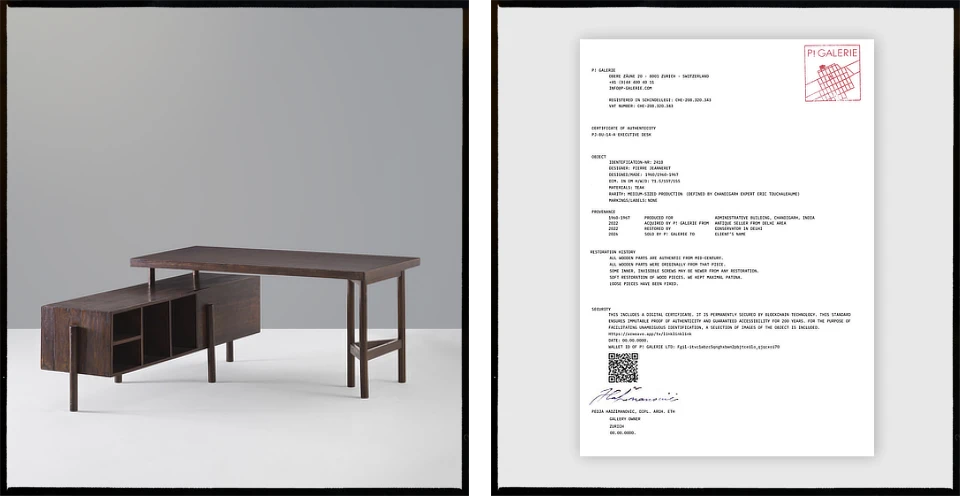
A blockchain certificate is an authenticity certificate for a design object.1 It can be verified at any time and from anywhere, and a later change to the information is detectable.2 Many physical certificates of design objects today carry no photographs, or the attached photos are too small to establish that the certificate belongs to a specific item. In addition, the colours of photos fade and information can be manipulated by hand, so certainty decreases over time. Certainty is the main function of a certificate: clear evidence over the long term. Purely physical certificates remain provable only as long as the selling gallery exists; after that, verification becomes difficult. This leads to losses in value and to difficulties for later owners and descendants.
Blockchain certificates are therefore a response to a market problem, particularly evident in Chandigarh design. The buyer receives a physical certificate with a link, the issuing gallery has the certificate in its system, and it is additionally stored on a blockchain as a PDF document.
CHANDIGARH ITEMS AND DOCUMENTATION
Chandigarh furniture was never sold in the conventional sense. It was distributed or auctioned off in bulk. Purchase receipts for individual pieces rarely exist. Provenance often relies exclusively on oral tradition, making these objects vulnerable to falsification. The situation is complicated further because purchase documents from India are relatively easy to forge and it cannot be excluded that employees of public institutions are bribed. At the same time, an object must have been acquired lawfully.
On 22 February 2011 the Indian Ministry of Home Affairs, which administers the Union Territory of Chandigarh, issued an order that, according to press reports, prohibits the sale, disposal, removal and export of furniture designed by Pierre Jeanneret and Le Corbusier owned by the Chandigarh Administration and other public bodies in the city.3 Many pieces left public ownership through scrap sales by the administration in the late 1980s and early 1990s, long before the order, and passed to private owners.4 Objects removed after 2011 are treated by the Indian authorities as unlawfully removed.5 The date on which an object passed from public to private ownership therefore matters, and the certificate records it.
BLOCKCHAIN AS THE SOLUTION
Blockchain technology enables digital provenance documentation in which a retroactive change is detectable. The record is stored permanently.2 Even if the physical document is lost or the gallery dissolves, the certificate remains preserved and accessible. The blockchain secures the entry, not its content: the record is only as reliable as the data entered. The link between the physical object and the record is established by the issuing gallery: through its expertise, the examination of the object, photographs of identifying features and a condition report.6
WHAT IS DOCUMENTED
A blockchain certificate contains documentation: the authenticity of the object, a condition report, photographs for identification, the restoration history, as well as the expertise and verification by the issuing gallery. The current change of ownership at the time of certification is recorded.
SECURING PROVENANCE FOR GENERATIONS
The significance of these certificates becomes clear when objects are passed on to descendants or sold. In both cases, the reputation of the issuing gallery and the completeness of the documentation are decisive. Where objects are documented in this way, the market becomes more transparent and forgeries become easier to identify. Documented authenticity supports the value of an object.
The certificate documents the object in a form that remains verifiable for later owners.
NOTES
1 Claudia Giannoni, Francesca Medda and Silvia Bartolucci, “Blockchain Technologies and Art: Opportunities and Open Challenges”, SSRN Electronic Journal, 2023, p. 7, https://doi.org/10.2139/ssrn.4439318.
2 Giannoni et al. (note 1), p. 3.
3 The Tribune, “10 heritage items sold for Rs 79.16 lakh in US”, 9 June 2023, https://www.tribuneindia.com/news/chandigarh/10-heritage-items-sold-for-rs-79-16-lakh-in-us-515505. The order itself is not published; the reports rely mainly on Ajay Jagga, member of the Heritage Items Protection Cell of the Chandigarh Administration.
4 The Tribune, “Explainer: Why Chandigarh’s heritage furniture keeps selling abroad”, https://www.tribuneindia.com/news/explainers/explainer-why-chandigarhs-heritage-furniture-keep-selling-abroad/.
5 The Tribune, “Chandigarh’s heritage recovery: How UNIDROIT, UNESCO gave India the legal lever it never had”, https://www.tribuneindia.com/news/chandigarh/chandigarhs-heritage-recovery-how-unidroit-unesco-gave-india-the-legal-lever-it-never-had/.
6 Giannoni et al. (note 1), pp. 4, 8, 15.