On the Authenticity of Historic Chandigarh Furniture
AUTHENTICITY
With Chandigarh items, authenticity is essential. It concerns not only shape but history and value. Two questions follow: what must remain original, and which parts may be replaced? At P! Galerie all solid wooden parts of a piece are original to it. Damaged components are never replaced with new ones, and parts are never taken from other damaged pieces. Where the limits lie must be defined. Many items are damaged, and dealers draw these limits differently. Buyers should discuss the gallery’s policy before buying.
Veneer is a separate case and depends on the piece. The thin veneer is glued to plywood. It is more fragile and has often been replaced over the last seventy years. In the gallery’s experience, auction houses and established galleries accept a replaced veneer top as part of the Chandigarh reality, but many omit it from the certificate. The type of replacement should be documented there.
Replacing cushions, cane, upholstery or foam is standard and does not affect value. Repainting metal parts is another matter, and opinions differ. P! Galerie does not repaint; other galleries are less strict. Pedja Hadži-Manović, gallery owner, says: “The richness, depth, and traces of use and time in the paint are essential to the item’s character, history and value. I consider repainted objects worthless.” Some buyers prefer a more presentable condition, and many galleries follow this wish and repaint.
Some furniture was repaired between 1960 and 1985. These repairs now carry their own patina and are part of the piece’s history. They do not necessarily reduce value, and many are well executed. Much depends on the piece, the extent of the intervention and the kind of restoration. Full documentation is required.
For additional stabilisation, objects are sometimes dismantled and inner screws added. Such work can be necessary, but it must be done professionally and remain invisible from outside. Each piece needs its own approach, balancing usability and originality.
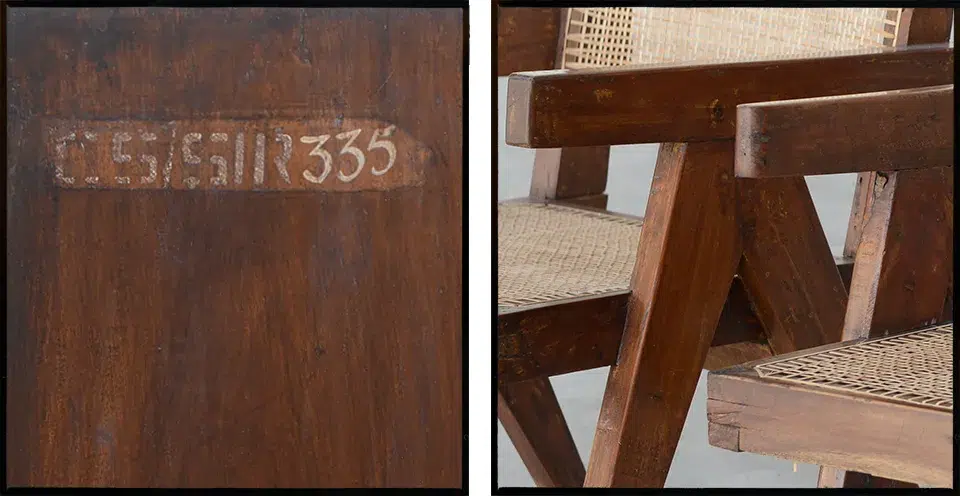
The furniture shows its history in its imperfections: old cracks, layers of scratches, worn lacquer, oxidation from decades of use. These are evidence of authenticity. Falsifications are increasing on the market, so it matters to buy pieces whose evidence has not been lost to poor restoration. Buyers should accept the character of a piece and avoid manipulated ones, which may look more pleasant at first glance. At P! Galerie, deep scratches or holes are treated discreetly so that they do not dominate the overall impression. Buyers should ask the gallery about interventions and choose one with proven experience in this field.
SELECTION PROCESS
Pedja Hadži-Manović selects every piece for P! Galerie personally and buys only unrestored furniture. Reliable invoices do not exist. Documents that surface in India are easy to falsify and prove nothing about a single object. Visual examination of each piece is therefore decisive: it shows the true condition and exposes manipulation. Restored pieces often lose vital indicators, so every object must be examined in its unrestored state.
P! Galerie looks closely at the surface and its quality. It therefore avoids sanded or otherwise strongly manipulated surfaces, where information has been erased, and the popular black Chandigarh pieces, since dark paint can hide manipulation. An auction house typically acts as agent for the seller. Its descriptions and condition reports are expressed as opinion, and any warranty is limited by its conditions of sale.[1] A gallery sells in its own name; its certificate is the seller’s written warranty. Hadži-Manović holds that gallery owners must be “paranoid”, not only to protect their reputation and clients, but because knowingly selling a falsification constitutes fraud.
RESTORATION
Restoration requires a balance between preservation and usability. These collector pieces derive their value from authenticity, so restoration must be minimal. Sanding is excluded: it destroys the character of a piece and erases the evidence of its authenticity. Small holes, cracks, old chips, irregularities and insect damage are to be expected, especially on the undersides, which galleries such as P! Galerie leave untouched.
OWNING CHANDIGARH FURNITURE
These are old pieces made for daily use, with one caveat: cane seats need attention. Cushions prolong their life, although Hadži-Manović does not use them himself. The patinated wood is resilient. New scratches become part of the surface and blend in among countless others; a little polish or stain makes them nearly invisible. Broken parts can be repaired. Damaged items are often discarded at once. Chandigarh pieces carry a history of destruction and repair.
NOTES
[1] Christie’s, Conditions of Sale, New York, 23 April 2026, preamble (Christie’s acts as agent for the seller unless it owns the lot) and section A.1(b) (descriptions and condition reports are opinion, not statements of fact), https://www.christies.com.cn/pdf/Live/LiveConditionsOfSale-NewYork-23APR26.pdf; Phillips, Conditions of Sale and Authorship Warranty, New York, effective 15 October 2020, section 2 (Phillips as agent), https://www.dist.phillips.com/content/web/docs/forms/Conditions_of_Sale_NY.pdf. Scope and duration of the warranties must be checked against the printed conditions of the sale in question.
LITERATURE
Eric Touchaleaume and Gérald Moreau, Le Corbusier, Pierre Jeanneret: L’aventure indienne, Gourcuff Gradenigo, 2010.